The Art of Customer Service Skills in Appliance Repair: 9 Essential Habits

Customer service skills never show up on a van stock list or a tool order, yet they decide more about an appliance repair business than most things that do. A customer can't tell whether your tech checked the right component. They can tell whether someone answered the phone, showed up when promised, protected the floor, and explained the bill in words that made sense.
That's the art of it. The repair is what you sell, but the customer experience is what people remember, review, and repeat to the neighbors. Here are nine habits great appliance repair teams practice, from the first call to the follow-up text. Some belong to your CSR, some to your technicians, and the best ones belong to everybody.
Table of Contents
Why Customer Service Skills Are a Business Asset
It's tempting to file customer service under nice to have. The board is full, the phone keeps ringing, and a tech who fixes things beats a charming one who doesn't. All true, right up until you look at where next month's work comes from.
A household with a refrigerator, a range, a dishwasher, a washer, and a dryer has five machines that will each break down someday. The household that had a good experience calls you back without searching, and the one that had a bad experience finds somebody else. Reviews work the same way. They rarely mention the part you replaced, but they do say things like "texted before showing up" and "showed me what broke."
Good customer service changes the price conversation too. A customer who trusts the technician hears the repair price as advice, while one who feels rushed hears a sales pitch and wants time to think. And poor customer service has costs you can count: fee arguments at the door, refunds, one-star reviews, and hours of your week on phone calls nobody enjoys.
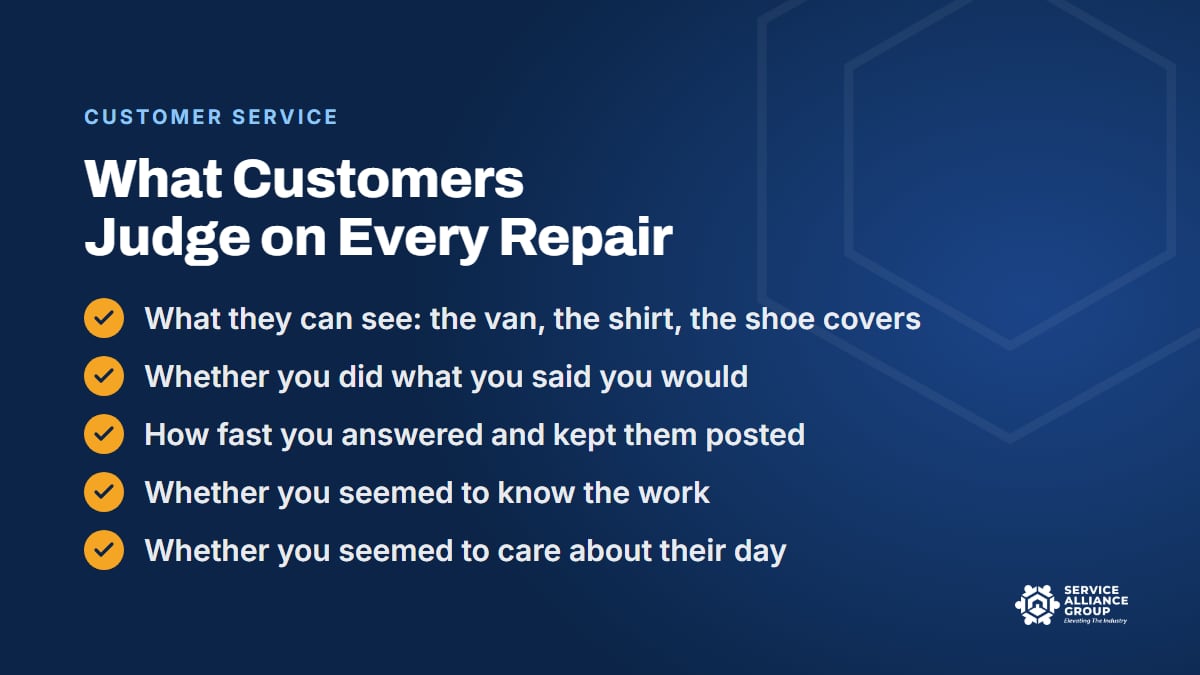
Customers tend to judge service on five things, whether or not they could name them:
- What they can see: the van, the uniform, the shoe covers, the drop cloth.
- Whether you did what you said: the arrival window, the price, the callback.
- How fast you responded: the answered call and the update when a part ships.
- Whether you seemed to know the work: confident answers and plain explanations.
- Whether you seemed to care: listening, patience, and respect for their home.
None of that is a personality trait. Customer service skills are habits, and habits can be taught, written down, and checked. The nine below cover all five.
Habits 1 to 3: Customer Service Skills on the Phone
For a lot of customers, your company is a voice before it's a van. Whoever answers the phone sets the tone for everything the technician walks into.
1. Listen to the whole story before you solve anything
A customer calling about a broken appliance is usually having a bad day. The refrigerator is full of groceries getting warm, or the washer quit mid-cycle with a tub full of water. Before that customer can hear anything you say, they need to feel heard.
Active listening sounds like one of the soft customer service skills, but on a repair call it's practical. Let the customer finish, and write down the symptom in their own words, because "it grinds for a minute and then shuts off" tells the tech far more than "washer broken." Then say it back: "So the washer starts, grinds for about a minute, and then shuts off. Did I get that right?"
That one question proves you were listening, and it catches the detail that changes what the tech brings. In this trade, empathy mostly looks like getting the details right. Acknowledge the situation once, then move to booking, because people want sympathy but they want an appointment more.
2. Set expectations before they turn into surprises
A lot of arguments in appliance repair aren't really about the repair. They're about something the customer didn't expect: a diagnostic fee at the door, a four-hour window when they pictured 9 a.m. sharp, or a second visit because a part had to be ordered. You can head off each one on the booking call:
- The diagnostic fee: what it covers and how it works if they go ahead with the repair, said the same way on every call.
- The arrival window: when it starts and ends, and that the technician will text when on the way.
- A possible second visit: many repairs need a part ordered, and a customer who hears that up front stays calm when it happens.
- Home warranty jobs: what the customer owes at the visit, and that coverage decisions belong to the warranty company.
Say the fee like it's normal, because it is. A CSR who apologizes for the diagnostic fee teaches the customer to argue with it. Our free Appliance Repair CSR Course covers booking and presenting the fee, with demo calls and downloadable script cards.
3. Know the trade well enough to ask the right questions
A CSR doesn't need to diagnose a dishwasher over the phone, but they do need to sound like they work at an appliance repair company. That means knowing which brands you service, how to help a customer find the model tag, and why an error code on the display is worth writing down. That kind of product knowledge is one of the most underrated customer service skills in the office.
It also means recognizing the calls that aren't routine. A gas smell, a burning smell, or water spreading across a floor is a safety call before it's a repair call, and your CSR should know your shop's written rule for each one.
All of it is cheap to teach: a one-page cheat sheet by the phone and a senior tech who answers the CSR's questions for ten minutes a week. "We work on that brand every day" lands differently than "Hmm, let me check."
Habits 4 to 6: Customer Service Skills in the Home
Your technician is often the only person from the company a customer ever meets face to face. For an hour or so, the tech is the company, and the customer experience lives or dies in their kitchen or laundry room.
4. Treat their home like it matters, because they're watching
Customers can't see inside a control board, but they see everything else. They notice whether the van blocks the driveway, whether the shirt is clean and the ID visible, and whether the tech smells like the last cigarette in the cab.
Inside, the standard doesn't bend. Shoe covers go on before the first step through the door, every time, even when the customer says not to bother. A clean drop cloth goes down before the tools come out, floor protection goes down before a refrigerator or range gets pulled from its spot, and the work area should look better when the tech leaves than it did when they arrived.
None of this is fussy. It's how a stranger earns the right to be in someone's house. Most of it gets decided before the knock, which is why we put together a pre-service checklist for the prep before every visit.
5. Explain what you found in plain words
A tech who works in silence for forty minutes and then announces a number looks like a tech making it up. A tech who talks through the work looks honest, even when the number is exactly the same.
Keep the updates short: what you're checking, what you ruled out, and what it means. Translate what you find, because "there's a sock stuck in the pump that drains the water" beats a part name the customer has never heard, and show them the failed part or a photo. Where there are real choices, lay out options instead of one take-it-or-leave-it price, then stop talking and let them decide.
A customer who understands what broke can say yes to the repair without feeling sold.
6. Tell the truth, even when it costs you the job
Honesty is the customer service skill that pays back slowest and longest. It shows up in four moments every technician faces:
- Repair or replace. When an older machine has an expensive failure, say so plainly and give the customer the numbers to decide. The tech who says "I wouldn't put that money into this one" is the tech they trust with the next appliance.
- The unfamiliar model. If you haven't worked on this exact unit, don't bluff. Tell the customer you're checking the service information for that model, then do it.
- The price. Give it before the work starts and stick to it. A surprise line on the invoice undoes an hour of good service.
- Other people's work. Never trash the last company, the brand, or the customer's choice of appliance. It makes you look small and makes them feel foolish.
Habits 7 to 9: Hard Moments and the Follow-Up
Anybody can be pleasant with a pleasant customer. The last three habits cover the harder moments and what happens after the van leaves, and they're where good shops pull away from average ones.
7. Read the customer and adjust
No two customers want the same visit. One homeowner wants to watch every step and ask questions. The parent on a work call wants a text with the price, and the property manager wants photos and a clean invoice. Pay attention in the first few minutes (how much they ask, whether they hover or disappear) and match it.
Patience is part of it. The customer who asks the same question three times is usually worried, not difficult, and nobody calls an appliance repair company because their day is going well. A short temper usually has more to do with the spoiled food or the pile of laundry than with you, so keep your own tone steady.
8. Handle complaints with a plan, not a reflex
When a customer is upset, the natural reflex is to defend yourself. Don't. Whether the complaint reaches the office or the tech at the machine, the same six steps work:
- Let them finish. Don't interrupt, even if you're sure they have it wrong.
- Acknowledge it. "I understand. I'd be frustrated too if the dryer quit again two weeks after we were out."
- Get the facts. What happened, when, and what they expected.
- Say what you'll do and by when. Promise only what you control.
- Do it, then confirm it's fixed. A quick call or text closes the loop.
- Write it down. The same complaint three times is a system to fix, not a customer to blame.
Callbacks need extra care. A customer whose machine fails again feels like they paid twice. Get back out fast, own what's yours, and make sure every tech knows what they can offer on the spot and when the owner has to make the call. This is where customer service skills pay off most, because a complaint handled well can earn more loyalty than a job that simply went fine.
9. Close the loop after the job
The customer experience doesn't end when the van pulls away. It ends when the customer stops thinking about the appliance, and until then every promise counts, right down to "I'll call you back by three."
- Parts on order: a text when the part is ordered, another when it arrives, and a call to book the return visit. Silence during a parts wait feels like being forgotten.
- Same day: a thank-you text with the technician's name.
- A few days later: a quick check-in, like "Is the dishwasher draining the way it should?"
- The review ask: every customer, in person before the tech leaves or in the thank-you text, with a link that makes it easy.
Keep that ask honest. Ask every customer, not just the ones who seemed happy, and never offer a discount, a gift, or anything else in exchange for a review. Don't write reviews for customers or have your own staff post them, either. Google's content policies prohibit those shortcuts, and the Federal Trade Commission's rule banning fake reviews and testimonials also bans incentives tied to what a review says and allows civil penalties.
The same follow-up keeps your name handy when a neighbor asks who to call, and our guide to customer referrals lays out a simple cadence.
Score Your Customer Experience From First Call to Follow-Up
You can't improve a customer experience you haven't looked at honestly. Once a quarter, walk through an ordinary week the way your customers live it and score each stage from 1 to 5.
| Stage | Ask yourself | Where to look |
|---|---|---|
| The call | Did we answer, listen, ask the right questions, and set expectations? | Recorded calls and the missed call report |
| The arrival | Did the tech text, arrive in the window, and protect the home? | Text timestamps and reviews |
| The visit | Did the customer understand the problem, the options, and the price before work started? | Declined repairs and reviews |
| The hard moments | Were complaints and callbacks handled fast and fairly? | The callback log and complaint notes |
| After the job | Did parts updates go out, and did every customer get a thank-you, a check-in, and the review ask? | Text history and the parts-pending list |
Score each stage yourself, then have your CSR and your techs score the same five stages on their own. Where your scores and theirs disagree, that's the conversation to have.
Then pick the lowest score and work on that one stage for four weeks before touching anything else. Score it again at the end, and listen for the difference in your check-ins and new reviews. For a weekly routine that keeps watch between those quarterly scores, see our post on how to monitor customer service.
How to Teach Customer Service Skills to Your Team
Some people show up with good customer service instincts. Everyone else can learn, and even the naturals get better with a system behind them.
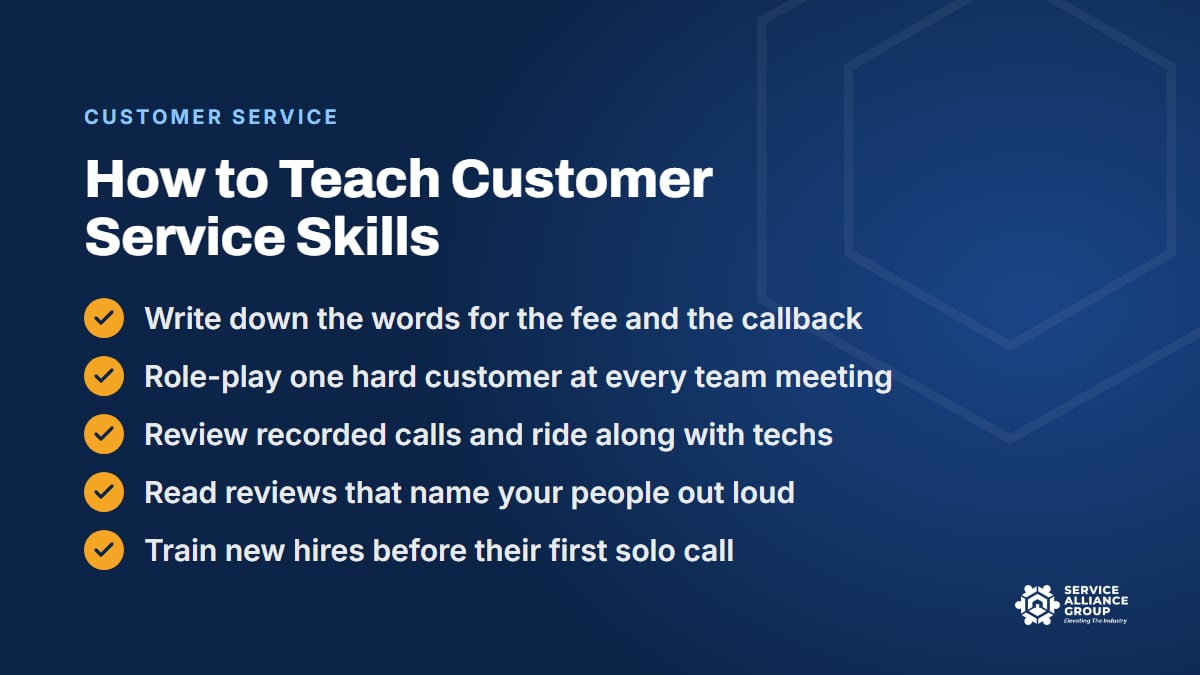
Here's what works in a shop without a training department:
- Write down what good sounds like. The words for the diagnostic fee, the part-on-order talk, repair or replace, and the callback belong in your written procedures, so every new hire learns the same version. The SOP Library has a Customer Service category to start from.
- Role-play the hard moments. Take ten minutes at a weekly team meeting. One person plays the customer who won't pay the diagnostic fee or whose dryer failed again, and the practice pays off the first time it happens for real.
- Listen to calls and ride along. Call recording consent rules differ by state, so check yours (or ask your attorney) before you record, and let callers know calls may be recorded. Then review a few calls with your CSR each week, and ride along with each tech now and then to watch the visit from the customer's side of the kitchen.
- Praise it where the team can hear. When a review names a tech or a CSR, read it out loud. Behavior that gets noticed gets repeated.
- Train before the first solo call. A new hire shouldn't learn customer service by trial and error on your customers.

Two Free Courses for Your CSR and Your Techs
We built two free courses that teach these customer service skills, one for each side of the business. Both live in the member portal.
The Appliance Repair CSR Course is for whoever answers your phone: 8 modules and 29 short lessons, with demo calls, downloadable script cards, and a final exam. It covers the call flow, booking and presenting the fee, safety triage, objections, complaints and difficult callers, warranty and home warranty jobs, missed calls, and speed to lead.
5 Star Service Calls is the in-home side: soft skills for technicians in 38 short lessons, with a final test. It runs from the on-my-way message and the knock to explaining in plain words, options instead of one price, handling pushback, asking for the review, the angry customer, and callbacks.
Hand the CSR course to the office and 5 Star Service Calls to every tech, veterans included, because the customer experience your shop delivers is only as consistent as its least-trained person. To hear how other owners train their teams, join The Alliance, our free private Facebook group of more than 5,500 appliance repair business owners.
Frequently Asked Questions
What are the most important customer service skills in appliance repair?
If you can only work on three, start with setting expectations on the phone, explaining the problem in plain words at the machine, and following up after the job. Those three head off fee arguments at the door, build the trust that gets a repair a yes, and bring customers back for the next appliance. Listening and honesty sit underneath all of them.
What is the difference between customer service and customer experience?
Customer service is how your people handle each moment: the call, the visit, the complaint. Customer experience is the whole path from the first search to the follow-up text, including what your systems control, like confirmation texts, arrival windows, invoices, and parts wait times. Great customer service skills can't rescue a broken process, so work on both.
Can customer service skills be taught, or do you have to hire for them?
Both. Hire people who are patient and like helping strangers, then teach the rest. Presenting a fee, explaining a failed part, and calming an upset customer can all be learned with written scripts, role-play, call reviews, and ride-alongs. Caring is much harder to teach, so screen for it in the interview and train everything else.
How can I tell if my team's customer service is slipping?
Watch the quiet signals: reviews that stop mentioning names, more calls asking where the tech is, more fee arguments at the door, more callbacks, and fewer past customers calling back for the next appliance. Listen to a few calls each week and read every review as it comes in, and you'll usually spot the slide before it shows up in revenue.
The art of customer service skills comes down to nine habits, practiced on ordinary Tuesdays by the person on the phone and the person at the machine. Pick your weakest one and start there this week.