
Should I Sell My Business? 7 Honest Questions for Appliance Repair Owners

Should I sell my business? For a lot of appliance repair owners, that question shows up late at night after a rough week: two callbacks, a van in the shop, a home warranty company sitting on a claim, and a phone that never stopped ringing. It is a fair question, and it deserves a better answer than the one you would give on your worst day.
The answer depends on two things that are easy to blur together: whether you are ready to leave, and whether the business is ready to sell. The seven questions below pull them apart.
Selling an appliance repair business also has legal and tax sides that depend on your state, your business structure, and your finances. Use this guide to organize your thinking, then take your answers to a qualified business broker, a CPA, and an attorney.
Table of Contents
Question 1: Why Do I Want to Sell My Business?
Start with the reason, because it shapes every decision after it. Write down your top three reasons for wanting out, and be blunt. Nobody else has to read the list.
Then sort them. Pull reasons move you toward something: retirement, your health, family, a new venture, or a serious offer on the table. Push reasons move you away from something: burnout, a tech who just quit, a slow season, or another night of invoices at the kitchen table.
Pull reasons tend to hold up. Push reasons deserve a second look, because many of them are problems with how the business runs, not with owning it.
Test each push reason: would it still be true if the shop could get through a normal week without you? If not, the real question may not be "Should I sell my business?" yet. It may be "What do I fix first?"
None of this means you need a noble reason. Being tired of crawling behind refrigerators is a perfectly good reason to plan an exit. Just make it a plan, instead of letting one bad month decide for you.
Question 2: What Happens to Me After I Sell My Business?
Owners tend to spend years thinking about the price and very little time thinking about the Monday after closing. Both matter.
The money. The headline price is not what lands in your bank account. Taxes, payoffs on van loans and other debt, broker fees, and legal and accounting costs all come out of it, and any seller financing is paid to you over time and depends on how the new owner runs the shop. Work out what you need with a CPA and a financial planner before you decide what you would accept.
The work. Expect a buyer to ask you to stay on for a transition: introducing them to commercial accounts, walking them through your parts and home warranty portals, and taking calls from longtime customers who ask for you by name. That can mean months working for someone else in the shop you built.
The life. A buyer may also ask for a non-compete that keeps you out of appliance repair in your area for a set time. What is enforceable depends on your state, so have your attorney review it. If the shop is part of who you are, talk it through with your spouse or partner, and have a real answer to "If I sell my business, what do I do on Tuesday morning?"
Question 3: Could the Shop Run 30 Days Without Me?
This question moves the price as much as any on the list. A buyer pays for a business that keeps producing profit after you leave. If the business is really you with a few vans around you, the buyer is buying a job, and owner dependence drags down any business valuation.
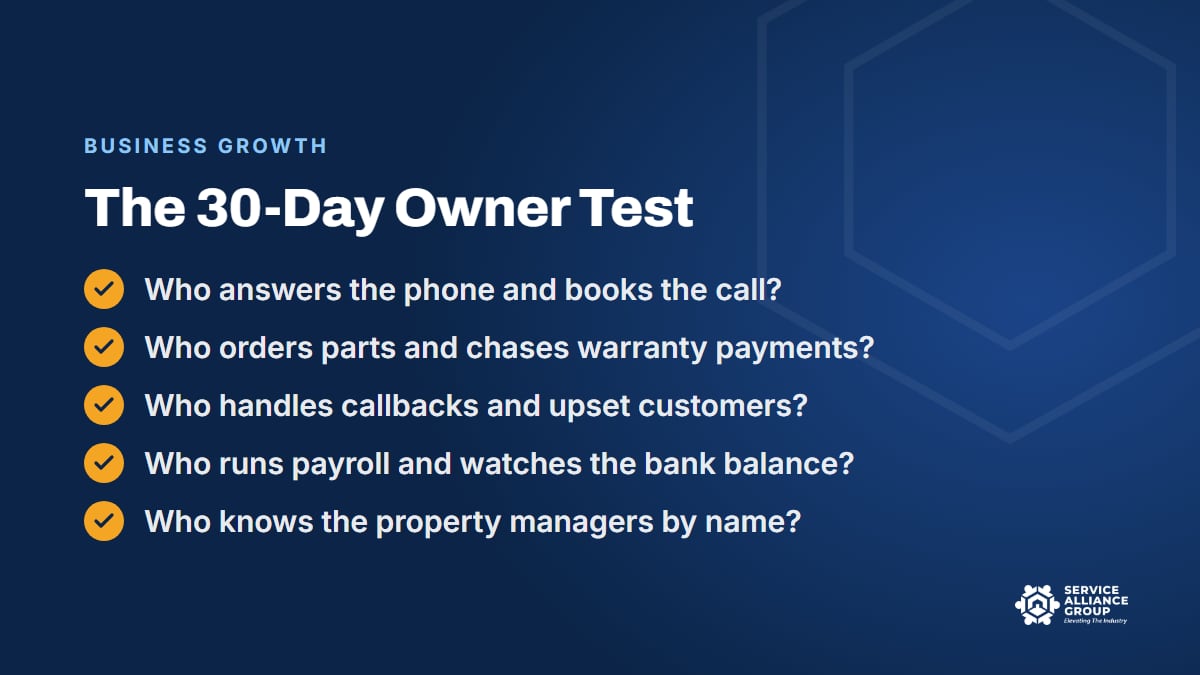
Picture yourself gone for 30 days with your phone off. What stops?
- Who answers the phone, presents the diagnostic fee, and books the call?
- Who builds the dispatch board and reshuffles it when a tech runs long?
- Who orders parts and chases home warranty payments?
- Who handles callbacks and the customer upset about a second visit?
- Who runs payroll and watches the bank balance?
Every item that stops without you is risk, and buyers price risk. Handing those jobs off takes time, so start well before you plan to list. Our guide to standard operating procedures explains how written systems protect a shop from key-person risk, and when you sell, the key person is you. The SOP Library gives you editable documents to start from instead of a blank page.
Relationships count too. If your biggest property manager and your best repeat customers would drift away the day you left, those relationships are worth less to a buyer than they are to you.
Question 4: Would My Books Hold Up to a Buyer's Questions?
Buyers, and the lenders who finance them, believe tax returns and bank statements, not stories about how good last year really was. When the paperwork and your description disagree, the price follows the paperwork. Few things slow down selling an appliance repair business like books a buyer cannot trust.
These problems tend to surface once a buyer starts asking:
- Home warranty receivables nobody has reconciled in months
- Vans and equipment held in your personal name instead of the company's
- A balance sheet that still lists a van you sold or a loan you paid off
- Owner perks and one-time costs you remember but never documented
When a buyer works out what the business really earns, some owner costs can be added back: your salary, perks run through the business, and one-time expenses. Each add-back needs a receipt or record and a short explanation. A buyer's accountant will question every one, and a long list with nothing behind it makes the rest of your numbers harder to believe.
Start the cleanup now, because one tidy month proves very little, and clean books are the foundation of any business valuation. Let your CPA lead it. Meanwhile, start a folder with what a buyer's team will ask for first: several years of tax returns, monthly financial statements, bank statements, payroll reports, a list of every loan and lease, and an aging report on home warranty and commercial receivables.
Question 5: What Would a Professional Business Valuation Say?
The price you need and the price a buyer will pay are two different numbers. A business valuation tells you where the second one probably sits, and why.
How small repair shops are usually valued
Owner-operated shops are usually valued on earnings, most often seller's discretionary earnings (SDE): the profit on your tax return plus your salary, documented owner perks, interest, depreciation and amortization, and one-time costs. Larger companies run by a manager are often valued on EBITDA (earnings before interest, taxes, depreciation, and amortization) instead. A buyer applies a multiple to those earnings, and the multiple largely reflects risk. The value of the vans, tools, and parts inventory often acts as a rough floor, and recent sales of similar businesses add a reality check.
For example, say a shop shows $140,000 in SDE. At a multiple of 2, that is a $280,000 price, and at 2.5 it is $350,000. That $70,000 difference comes down to how risky the next few years look to the buyer. These numbers are invented to show the math, and they are not a benchmark for repair shops or a prediction of what yours is worth.
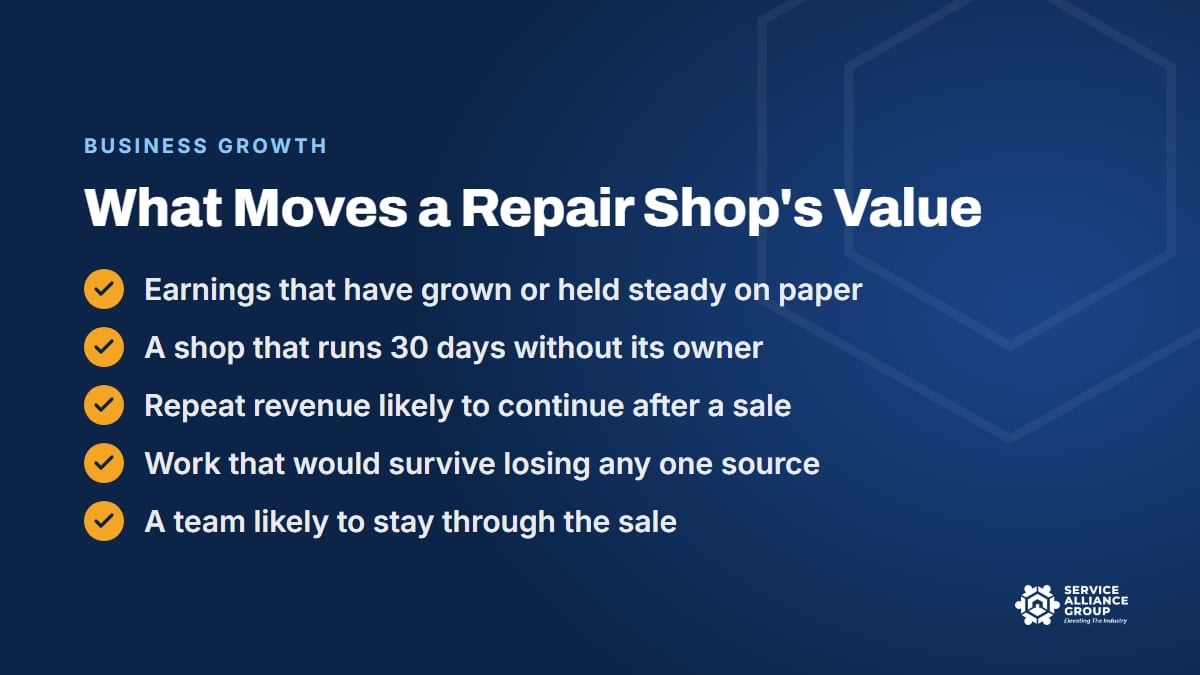
What moves the multiple for an appliance repair shop
- Owner dependence: everything in Question 3
- Earnings that have grown or held steady, backed by clean books
- Repeat revenue a buyer can expect to keep coming after the sale
- Concentration: how much work would disappear if your largest source of calls went away
- A stable team likely to stay through a change of ownership
- Transferable assets like reviews, a Google Business Profile the company controls, phone numbers, a domain name, and a customer list with service history
- Condition of the vans, plus parts inventory that will actually sell
Who should do your business valuation
A business broker can give you an opinion of value based on sales of similar businesses. A credentialed business appraiser can prepare a formal business valuation, which is often needed for a family transfer, a partner buyout, or estate planning. If you can, get one a few years before you plan to sell, while there is still time to fix what it exposes.
Question 6: Who Would Take Over, and How Would the Deal Work?
Selling an appliance repair business to a stranger is only one way out, and knowing the realistic options changes how you prepare.
- An individual buyer, who may or may not come from the trade. Many need a lender, so your tax returns get picked apart, and the lender may want its own business valuation.
- Another appliance repair company that wants your techs, customer list, and route density. They know the trade, so weak numbers will not get past them.
- A larger company or investor group building a bigger service operation, which usually wants a shop that already runs without its owner.
- Family. A son or daughter may want to take over, which raises questions about price, taxes, and fairness to other family members, and often calls for a formal business valuation.
- Your own team. A lead tech or office manager can be a natural buyer, but employees rarely have the cash, so these deals often rely on seller financing.
- Closing and selling the assets. Vans, tools, and inventory usually bring far less than a running business, but for a one-person shop it is sometimes the honest option.
Deal terms to recognize
A deal might sell the company's assets or the company itself, and how the price is split among vans, tools, goodwill, and a non-compete affects taxes on both sides. Part of the price might come as seller financing or as an earnout tied to future results. Your business structure shapes the options too, and the SBA's overview of business structures explains the basics.
Then there are details specific to this trade. Who collects the home warranty receivables, and who covers callbacks on repairs finished before closing? Can your home warranty and manufacturer service agreements transfer? Licenses may not transfer automatically either, so check your state and local rules along with the SBA's guide to licenses and permits.
Have your attorney and CPA review everything before you sign a letter of intent, because parts of that document can be binding.
Question 7: Is Now the Right Time?
The best time to sell is when your personal timing and the business's timing line up, and that rarely happens by accident.
Sell from strength. Buyers pay for the trend. Earnings that have grown for a few years support a stronger business valuation than the same earnings after a flat stretch, and selling right after your worst year prices in your worst year.
Give yourself a runway. Clean books need time to show a pattern, and a lead tech needs time to grow into running the board. If you are thinking, "I want to sell my business in three years," the preparation starts this month.
Leave the economy out of it. Interest rates affect how much buyers can borrow, but nobody times them reliably. Put your energy into profit, owner dependence, and documentation.
Keep running hard during the sale. Selling an appliance repair business can take many months, and if marketing slips or calls go unanswered while you meet with buyers, the numbers dip right when a buyer's accountant is looking. Keep it confidential too, because techs who hear a rumor may start updating their resumes.
If your answer is "not yet," use the time well. Our 21 tips to build a business worth buying turn the weak spots these questions uncover into a practical to-do list.
What Your Seven Answers Are Telling You
Lay your answers side by side. They will usually point to one of four places.
| Where you land | What it usually means | Next step |
|---|---|---|
| You are ready, and the shop runs without you on clean books | You may be able to sell from strength | Build your advisor team and get a business valuation |
| You are ready, but the shop still runs through you | It is likely worth less than it could be | Spend a year or two on owner dependence and the books |
| The shop is ready, but you are not | Owning a shop that runs without you may suit you | Step back from daily work and revisit next year |
| Neither is ready yet | The question may have come from a hard stretch | Start with Questions 3 and 4, then ask again in six months |
What selling an appliance repair business involves
Every deal is different, but the process usually runs in this order:
- Build your team: a business broker, a CPA, an attorney, and a financial planner.
- Get the valuation and clean up whatever it exposes.
- Go to market quietly. Your broker screens buyers and gets a confidentiality agreement signed before anyone sees your numbers.
- Negotiate a letter of intent covering price, terms, and your transition.
- Work through due diligence, with questions about every add-back, large account, and van.
- Close and hand it over.
Want to hear how other owners think about succession? Ask in The Alliance, our free Facebook group with more than 5,500 appliance repair owners.

Where the S.O.S. Course Scale Stage Fits
The things that make selling an appliance repair business go well get built years before the sale, and much of that groundwork is covered in the S.O.S. Course: one course in three stages (Start, Operate, Scale), worked in order.
The Operate stage builds the numbers a buyer will ask about, including KPIs, job costing and the weekly P&L, and the 13-week cash forecast. Alongside hiring, the management layer, and commercial work, the Scale stage covers business valuation and exit options, including what drives a repair shop's value, cleaning up your financial documentation, and the ways an owner can step away.
The course is 70 lessons and more than 21 hours, with 70 downloadable tools including 12 live spreadsheets, a quiz at the end of each stage, a master test, and a certificate of completion. It comes from Service Alliance Group, whose co-founder TK Cousins runs a profitable multi-tech appliance repair company he built from the ground up.
Your broker, CPA, and attorney still handle the deal itself. The course can help you walk into those meetings with your numbers in order and better questions to ask, and you can see what each stage covers in the member portal.
Frequently Asked Questions
How much can I sell my business for?
It depends on what the business earns, how reliably it will keep earning without you, and how well you can prove both. Rules of thumb and online calculators can give a rough range, but they cannot see your add-backs, your owner dependence, or how concentrated your work is. For a number you can plan around, get a professional business valuation from a business broker or credentialed appraiser.
Who should I talk to before I sell my business?
Start with a CPA, who can clean up your financial statements and explain the tax side of different deal structures. Bring in a business broker for an opinion of value and a confidential sale, and ask how they are paid and whether they have experience selling an appliance repair business or a similar service company. Hire an attorney before you sign anything, including a listing agreement or letter of intent.
How long does selling an appliance repair business take?
Plan for longer than you expect. Preparation can take a year or more if the books need cleanup or the shop depends heavily on you. The sale itself, from listing through due diligence, buyer financing, and closing, can run for months on its own. Starting early gives you room to fix problems and the freedom to walk away from a bad offer.
Can I sell my business to one of my employees?
Yes, and a lead tech or office manager who already knows your customers can be a strong fit. Since few employees can pay the full price up front, part of the price is often paid to you over time through seller financing, so your payments depend on how the shop performs after you leave. Handing over pieces of the job well before closing lowers that risk. Get a professional business valuation, and have an attorney and CPA structure the terms.
Selling is one of the biggest calls you will make as an owner, so make it on purpose. Answer the seven questions, get your numbers straight, and bring in the right professionals. The next time you catch yourself asking, "Should I sell my business?" you will have a real answer instead of a bad week talking.