How to Market an Appliance Repair Business Without Spending a Fortune

You can market an appliance repair business without spending a fortune. Low-cost marketing is the foundation every paid campaign stands on, and if you skip it, you usually end up paying more for every job you book.
Good appliance repair marketing is mostly unglamorous work done consistently. Below are eleven low-cost tactics, from your Google Business Profile to the van in your driveway. They cost time more than money, and they work best in order, because each one makes the next one pay off.
Table of Contents
Why the Order Matters When You Market an Appliance Repair Business
Follow a customer from the first search to the fifth repair. They find you, decide whether to trust you, call, get booked or do not, and then either remember your name or forget it. Marketing money spent at the top of that path leaks out wherever a step below it is broken.
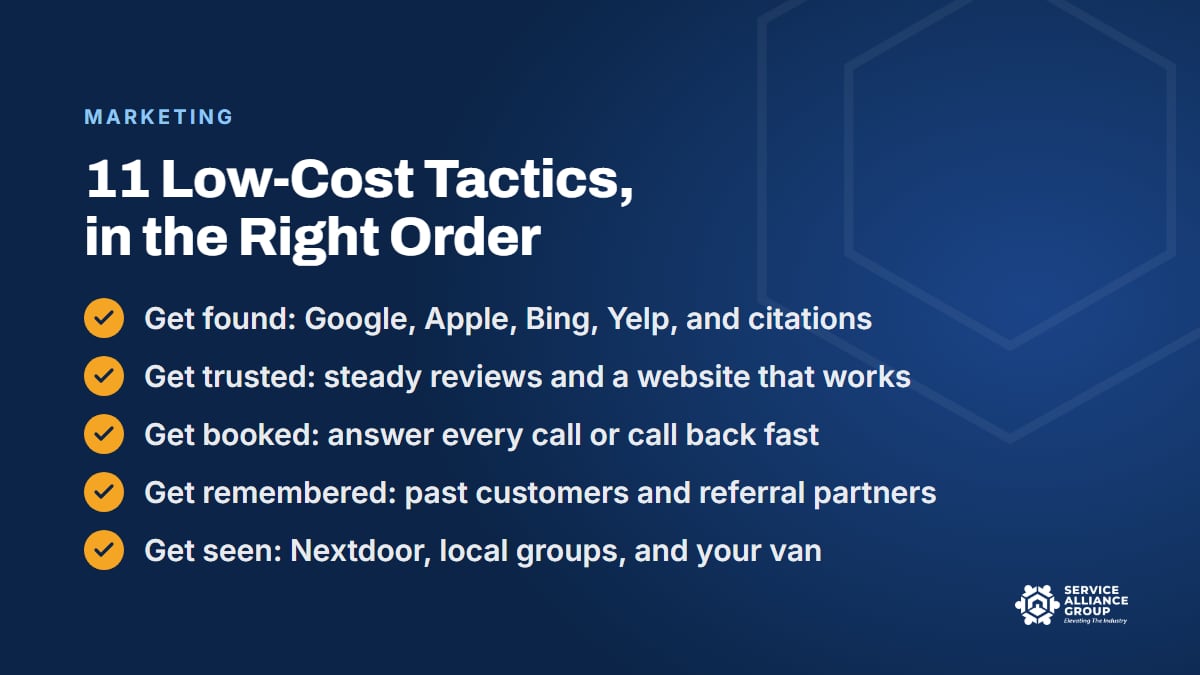
That is why this list starts with being found, moves through trust and the phone, and ends with the customers you already have. It is tempting to market an appliance repair business by starting with ads, because ads feel like action. But an ad cannot fix a profile with three reviews or a phone that rolls to voicemail. It just sends more people to find those problems.
There is a second reason to start here. Much of this work builds something that stays with your business: a complete profile, a pile of honest reviews, a customer list, and relationships around town. Paid marketing stops the day the budget does.
Get Found: Claim Every Free Listing
1. Finish your Google Business Profile
If you do only one thing to market an appliance repair business, finish this profile. It is free, and it is the listing people see on Google Maps and in the map results on Google Search.
- Use your real business name, exactly as it appears on your van and invoices. Google's Business Profile guidelines do not allow extra keywords or taglines in the name, and a stuffed name puts the profile at risk.
- Choose "Appliance repair service" as your primary category. Google asks for the fewest categories that describe your core business, so add others only when they truly fit.
- Hide your address if customers do not come to you, and set a service area instead. Google allows up to 20 service areas and asks that the whole area stay within about two hours of driving time from where you are based.
- Fill in everything else: hours (including holidays), your services, a plain description of what you fix and where, and real photos of your team, vans, and work.
2. Claim your listings on Apple Maps and Bing
Not everyone searches on Google. People who look you up in Apple Maps or ask Siri see whatever Apple has on file for your business, and you claim and manage that listing through Apple Business (formerly Apple Business Connect).
Bing Places does the same job for Bing and Bing Maps, and Bing also sits behind Microsoft's Copilot assistant. Bing Places can import your details straight from your Google Business Profile, one more reason to finish that profile first. On both platforms, keep your name, phone number, and hours identical to your Google profile. If customers do not come to your address, check whether each platform will show that address publicly before you finish.
3. Set up Yelp and follow its rules
Claim your free Yelp business page, fill it out completely, add real photos, and reply to reviews there, too. Some homeowners check Yelp before they call anyone, and an unclaimed page with an old phone number sends those calls to a dead line.
Yelp handles reviews differently from Google. It tells businesses not to ask anyone for reviews, and its software may not recommend reviews that look requested. So point your review requests at Google and let Yelp reviews come on their own. Yelp ads are optional; a complete free page is the place to start.
4. Clean up your citations
A citation is any listing of your business name, phone number, and address or service area on another site: directories, the Better Business Bureau, your chamber of commerce, Facebook, and Nextdoor, among others. A small shop does not need hundreds of them. It needs the ones that exist to be right.
Search your business name, your current phone number, and every old number or address you have used. Fix each listing with wrong details, and merge or remove duplicates, because conflicting information confuses customers and gives search engines a reason to doubt which version is true.
Keep a simple spreadsheet of every listing and who has the login, so the next change to your hours takes one sitting instead of a scavenger hunt. Skip marketing services that promise hundreds of directory listings for a fee. Our post on service area business SEO covers how listings fit into local rankings.
Get Trusted Before the Phone Rings
5. Make asking for reviews part of every job
Reviews are marketing your customers write for you, and they cost nothing but a habit. Build the ask into the end of every job: the tech shows the customer the appliance working, thanks them, and asks whether they would share how the visit went. The office texts a direct link to your Google review page the same day, so the customer can write it on their own time.
Ask every customer, not only the ones who seemed happy. Google's policy against rating manipulation rules out selectively asking for positive reviews, offering discounts or anything else in exchange for a review, and asking staff to collect a set number of reviews. So do not hand your techs review quotas, and never buy reviews. Our post on why you should never pay for Google reviews explains what is at stake.
Reply to every review within a day or two. Thank the good ones and mention the appliance. Answer a bad one once, calmly, with an offer to make it right offline, because the reply is really written for the next homeowner reading it.
6. Get the website basics right
Your Google profile earns the click, and your website is where your other marketing sends people to decide whether to call. It does not need to be fancy, but on a phone it needs to:
- load fast and show a tap-to-call phone number on the first screen
- say which appliances and brands you fix and which towns you serve
- show real reviews and real photos of your team
- explain your diagnostic fee on a simple pricing page
- offer a short booking form for people who cannot call
Most of those are edits, not a rebuild. We walk through each one in 6 tips to increase the conversion rate on your appliance repair website.
Get Booked: Stop Losing the Calls You Earn
7. Answer every call, and call back fast when you miss one
This one rarely shows up on marketing lists, and it may matter more than anything above it. Every hour and dollar you spend to market an appliance repair business is wasted on a call that rolls to voicemail, because a homeowner with a dead refrigerator rarely leaves a message and waits. They call the next number. No marketing plan survives a phone nobody answers.
You can plug a lot of that leak without hiring a full office:
- Decide who answers during the day when the owner is under a dishwasher, and write it down.
- Turn on an automatic missed-call text if your phone system offers one, so the caller hears from you right away and knows a callback is coming.
- Call back every missed call within minutes, not at the end of the day.
- Read the missed call report every morning, as our post on how to monitor customer service describes.
- When calls regularly slip through, price out a part-time CSR or an answering service with a real script.
Then train whoever answers. A call that collects the appliance, brand, and symptom and explains the diagnostic fee with confidence gives the homeowner a reason to book now instead of trying the next number. Our free Appliance Repair CSR Course teaches exactly that in 29 short lessons, including missed calls and speed to lead.
Get Remembered by the Customers You Already Have
8. Follow up with past customers
The customers you already served are one of the least expensive ways to market an appliance repair business, because you already paid to win them. Every one of them lives in a house full of appliances, and the next one to fail is likely to go to whichever company they remember. A simple routine keeps your name close:
- a thank-you text the day of the job, from a real person
- a check-in a week later to make sure the repair is holding
- a short seasonal note a couple of times a year, such as a dryer vent reminder before winter
- a yearly hello that simply reminds them you are still around
While the tech is in the house, note the other appliances, their brands, and their rough ages in the customer record, so your reminders can be specific. Keep every message plain and helpful. Marketing that reads like a weekly discount blast teaches people to ignore you.
Before you text or email customers for marketing, get their permission, include an easy way to opt out, and check the federal and state rules with a qualified professional. Your texting provider may also require you to register your business before it will send messages. Our 5-step guide to customer referrals lays out a full follow-up routine, including when to ask for referrals.
9. Build a short list of referral partners
Some local businesses run into broken appliances every week and have nobody reliable to call. A handful of good relationships can send you work all year:
- Property managers and landlords, who need a shop that answers, shows up, and sends a clean invoice
- Real estate agents and home inspectors, whose buyers find appliance problems in the middle of a sale
- Appliance stores without a service department, which hear from customers whose old unit may be worth fixing
- Short-term rental hosts, who need the dishwasher working before the next guest arrives
Walk in with cards and a one-page sheet that says what you fix, where you go, and a direct number that reaches a person. You can design that sheet, and most of your other printed marketing, yourself in Canva. Then close the loop on every job a partner sends with a quick text that says it is fixed. Hearing that the job was handled is what keeps partners sending the next one.
Get Seen Around Town
10. Show up on Nextdoor and in local groups
When someone posts "Who do you use for appliance repair?" in a neighborhood app or a town Facebook group, the replies come from neighbors, and neighbors get believed. That is word-of-mouth marketing happening in public. Claim your Nextdoor business page so past customers can find and recommend you when those posts appear.
In local Facebook groups, read the rules first, because many limit business posts. Join as yourself, the local owner, answer questions when you can genuinely help, and let happy customers do the recommending. Where business posts are allowed, a short safety reminder about cleaning the dryer lint screen goes over better than an ad. Our post on promoting your appliance repair company with social media covers setting up the pages.
11. Turn your van into a rolling sign
Your van spends the day parked in driveways in the exact neighborhoods you want to work. That makes it one of the few ways to market an appliance repair business that you pay for once and use every day. A full wrap looks great, but clean vinyl lettering does most of the job for less.
Keep it readable from across the street: your company name, the words "Appliance Repair," one big phone number, and your website. Skip the list of every appliance and the clip art, because a driver at a stop sign has a few seconds.
The van advertises your driving, too, and a wrapped van tailgating on the highway is marketing of the wrong kind. The small things that ride along count as well: clean shirts with your logo, a magnet on every customer's refrigerator, and door hangers for the neighbors on either side of a job if local and HOA rules allow them. Keep flyers out of mailboxes, which federal rules reserve for postage-paid mail.
Where Paid Leads Fit When You Market an Appliance Repair Business
Paid leads have their place. Local Services Ads with the Google Verified badge, Google Ads, and lead platforms can fill open slots on the schedule. But paid leads amplify whatever is already there. Send more callers into a shop with a thin profile, a slow site, and missed calls, and you pay to lose more jobs.
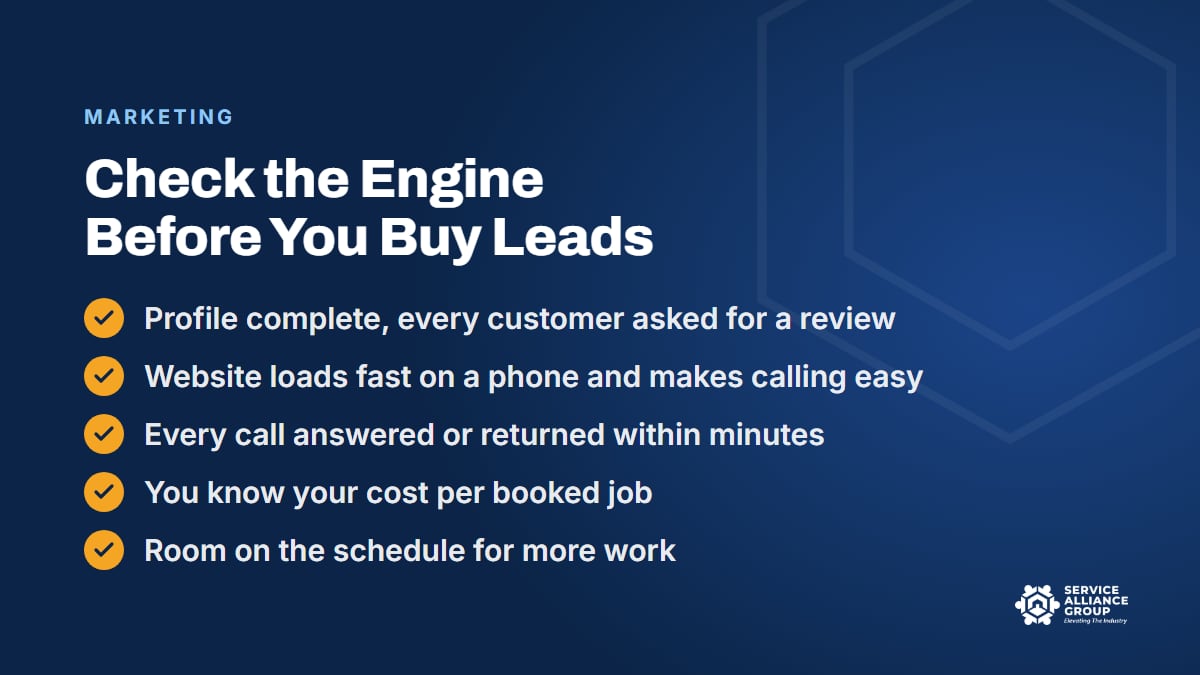
Before you put money into paid marketing, check the engine:
- Your Google Business Profile is complete, and you ask every customer for an honest review.
- Your website loads fast on a phone and makes calling easy.
- Every call gets answered or returned within minutes.
- You know what a booked job costs you from each source.
- You have room on the schedule for more work.
Then judge every paid source by cost per booked job, not cost per lead. For example, if you pay for ten leads and four of them book, divide what you spent by four, not ten. Compare that with what a customer is worth over the years they stay, which our article on how much a customer is worth walks through, and with your real costs from the free Cost of Doing Business calculator.
When the engine already runs, paid leads add fuel to something that works. That is when appliance repair marketing money goes furthest.
Put the Whole Engine Together
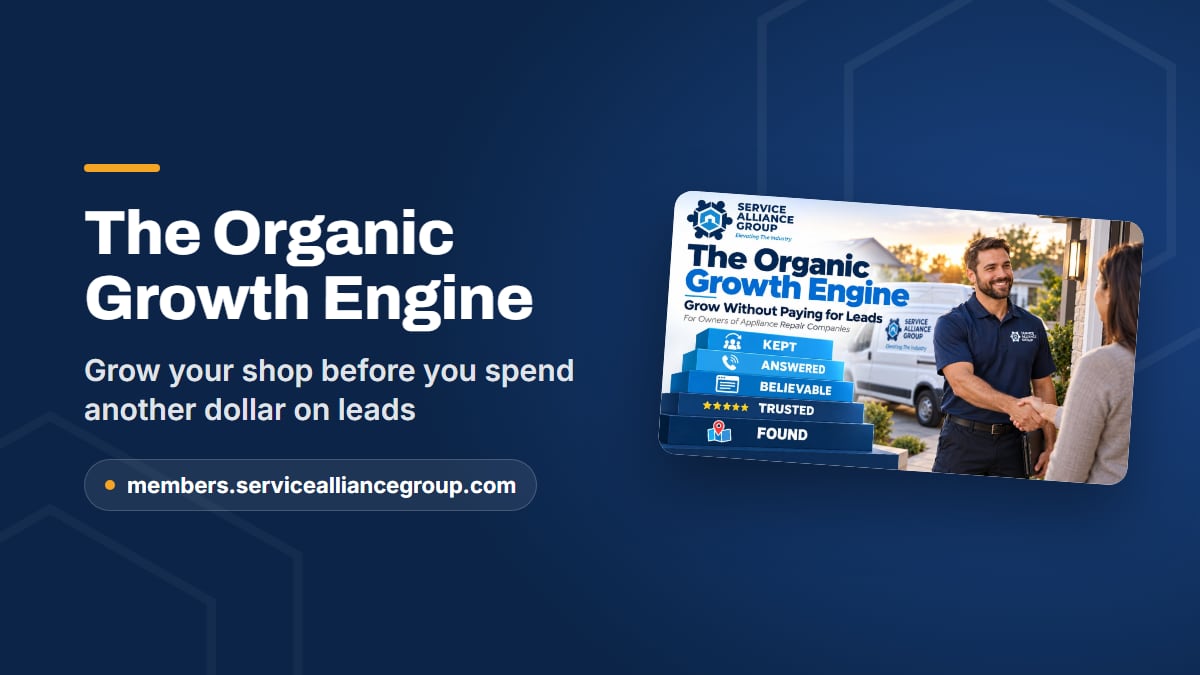
Most of the tactics above fit into one marketing system, and that system is what The Organic Growth Engine teaches. It is our course on everything an appliance repair company should do before spending on ads, built in five layers: getting found without paying, being trusted before they call, a website that holds up, a human who answers and books, and customers who come back and refer.
The lessons go deeper on each piece you need to market an appliance repair business: Google Business Profile, Apple Business and Bing Places, Yelp, citations, social and Nextdoor, reviews and the current rules, websites and pricing pages, answering and booking, follow-up and referral partners, and how AI assistants pick companies to recommend.
It is 47 short lessons and more than four hours, with 11 downloadable build sheets and trackers, a final exam, and a certificate. Mike Carson teaches it. He runs a marketing agency built around this industry and is CEO and Co-Founder of Service Alliance Group.
To hear what is working for other shops right now, join The Alliance, our free private Facebook group, where more than 5,500 appliance repair business owners trade notes on marketing, hiring, and everything in between.
Frequently Asked Questions
What is the cheapest way to market an appliance repair business?
Start with the free listings and the phone. A complete Google Business Profile, a steady review habit, and answering every call take more time than money, and they make every other marketing tactic work better. Next, follow up with past customers. They already know you, and the next appliance to fail in their house is a job you do not have to pay to find.
How much should I spend on appliance repair marketing?
There is no universal number worth copying. Base it on your own math: what a booked job costs you from each source, and what a customer is worth over the years they stay. Start with low-cost marketing, track where booked jobs come from, and add paid sources when the cost per booked job leaves room for profit.
Do I still need a website if I have a Google Business Profile?
Yes. The profile may get the first look, but many homeowners check the website before they call, to see what you fix, where you go, and what the visit costs. A simple site that loads fast, shows the phone number, and explains your diagnostic fee backs up everything the profile promises.
How long does low-cost marketing take to work?
Some of it works the same week, because answering every call and following up with past customers can bring in jobs right away. Listings, reviews, and referral partners build over months, since trust grows one customer at a time. Pick two or three tactics, run them consistently for a full season, and track where your booked jobs come from.
You do not need a fortune to market an appliance repair business. You need the low-cost pieces done well and in the right order. Then keep at them long after the novelty wears off.