Appliance Repair CSR Skills: 8 Proven Ways to Book More Calls

Your appliance repair CSR decides what happens to every call your marketing produces. Picture one homeowner with a dead dryer calling two shops that charge the same price. One shop books the job, and the other hears "let me think about it." The difference is the person who answered.
Phone skills can be taught. Here are the eight we would teach first, roughly in the order a call happens, with the words to use. Each one moves the same number: your booking rate, the share of qualified phone calls that end with a job on the schedule.
Table of Contents
Skill 1: Answer Fast and Call Back Missed Phone Calls
The first skill has nothing to do with what your appliance repair CSR says. A call that rings out books nothing, and a homeowner standing in an inch of water is unlikely to leave a voicemail and wait. They are more likely to dial the next shop.
Set a standard you can hold, like answering by the third ring during business hours, then find where phone calls get dropped. The usual gaps are lunch, the first hour when the CSR is also running the dispatch board, busy stretches when one person is already on a call, and evenings and weekends. Cover each one on purpose:
- Overflow: roll unanswered phone calls to a second person or to an answering service that books appointments, not one that only takes messages.
- Text-back: many business phone systems can text a caller automatically after a missed call: "Sorry we missed you. This is [Name] at [Company]. I'll call you right back, or reply here and tell me what's going on."
- A callback standard: every missed call gets a call back within minutes, not at the end of the day. Pick a target, write it on the board, and check it every morning.
- After hours: an on-call person, an answering service, or a greeting that says exactly when you will call back. Then keep that promise.
When you call back, lead with the reason: "I saw we just missed your call and didn't want you to wait. What's going on with the appliance?" Web form leads and texts deserve the same speed.
Skill 2: Follow One Call Flow From Hello to Booked
A good call has a shape. When your appliance repair CSR runs every call through the same flow, the customer hears someone in control, nothing gets skipped on a busy Monday, and you have something specific to coach against.
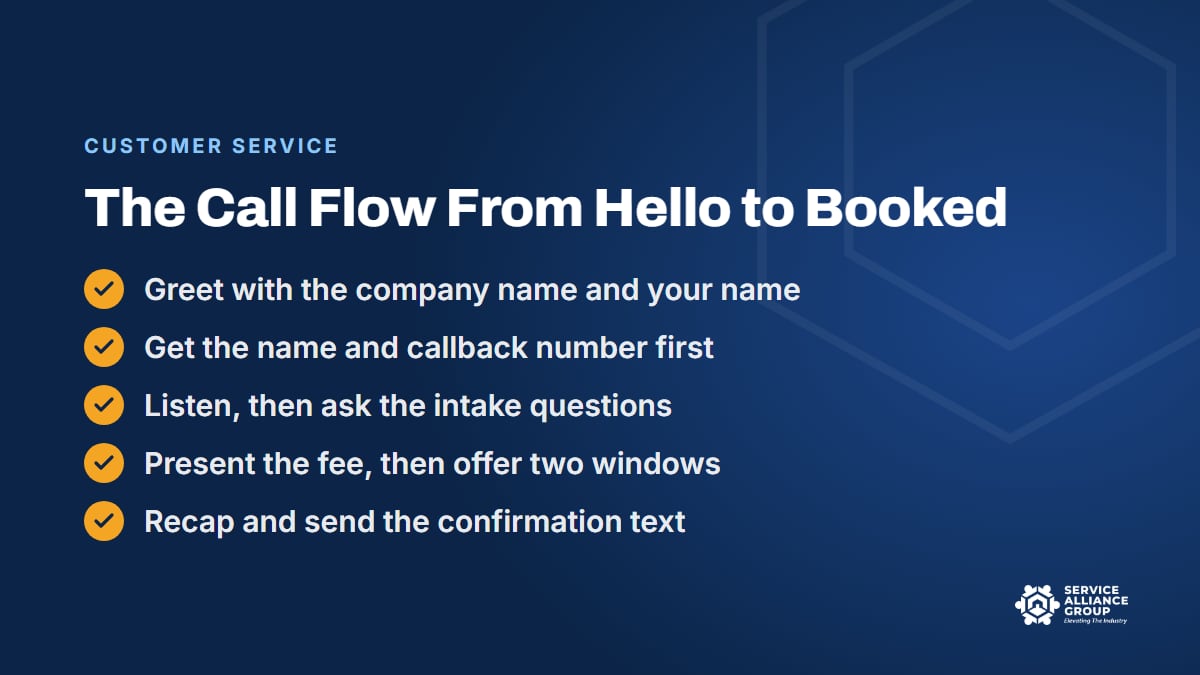
- Greet: "Thanks for calling [Company], this is [Name]. How can I help?"
- Get the name and callback number first, "just in case we get disconnected."
- Let them tell the story, then show you heard it: "A washer full of water with your towels stuck in it is a rough way to start the day. Let's get it handled."
- Ask the intake questions (Skill 3). If the caller mentions anything on your safety script at any point, even in the first sentence, stop and use the script (Skill 4).
- Present the diagnostic fee and what it covers (Skill 5).
- Offer two appointment windows and ask which one works better.
- Recap the booking and send the confirmation text (Skill 7).
A flow is not a script read word for word. Lock down the greeting, the fee, and the two windows, and let the rest sound like a person talking to a neighbor.
When a caller opens with "How much is this going to cost?" the flow keeps the CSR leading: "Good question. Let me ask a couple of quick things about the appliance first, and then I'll walk you through exactly what the visit costs."
Skill 3: Run Discovery and Qualify With an Intake Sheet
Discovery is where your appliance repair CSR sets up the technician. Every detail gathered on the phone is one the tech does not have to guess at in the driveway, and one more chance the right part is on the van for the first visit.
What goes on the intake sheet
Build the sheet, or the booking screen in your scheduling software, around these fields:
- Name, callback number, and service address, including the zip code
- Appliance, brand, and model number, plus roughly how old it is
- The symptom in the customer's words: "it's grinding and the drum won't turn," not "washer broken"
- Any error code on the display, exactly as it appears
- When it started, and whether anyone else has worked on it
- Warranty status: manufacturer, extended, or a home warranty plan
- Access notes: pets, parking, stairs, gate codes, and which door to use
- How they found you, so you know which marketing produces phone calls that book
For the model number, ask for a photo: "Could you text a picture of the model tag to this number? It's usually a sticker inside the door or lid, or along the door frame." A photo avoids misheard letters and dropped suffixes.
If the tag is hard to find, tell the customer not to pull the appliance out or take anything apart to look. Book the call anyway, and the technician will get the tag on site. Our pre-service checklist picks up where the call leaves off.
Qualify before you book
A job you should never have booked turns into a wasted drive and a frustrated customer. Get three answers before offering a window:
- Service area. Keep a zip code list at the desk, not in the owner's head, and make sure it lines up with your Google Business Profile. Google lets you set that area by city or zip code under its guidelines for service-area businesses.
- Appliance and brand. If you skip certain brands, built-in refrigeration, or commercial work, the CSR should know it cold and say so kindly, with the name of a shop that does that work.
- Warranty. Manufacturer warranty repairs usually go through that brand's authorized servicers, so if your shop is not one of them, say so before the customer pays you for a visit the warranty might have covered. Home warranty jobs usually start with a claim the customer files with the warranty company, which decides who goes out, so ask about it before you book.
Skill 4: Put Safety Calls at the Front of the Line
A few calls need to break the flow in the first sentence, and your appliance repair CSR has to recognize them instantly. Write a short safety script with your team, keep it to getting people safe, and tape it next to the phone.
- A gas smell. Stop the intake right there. Tell the caller to get everyone out of the home now and call the gas utility or 911 from outside, then end the call so they can go. A carbon monoxide alarm gets the same answer. Book the visit when they call back after the utility or the fire department has checked the home.
- Smoke, sparks, or a burning smell. If there is smoke, fire, or a burning smell right now, the answer is the same: everyone out, then call 911 from outside. If it happened earlier and has stopped, tell the caller not to use that appliance again until your technician has seen it, and book the earliest visit you can.
- Water on the floor. Tell the caller to stop using the appliance and keep people and pets away from any water near outlets or cords. Then book the earliest visit you can.
If a caller says they feel unsafe for any reason, the CSR takes their word for it: everyone out, then call 911 from outside.
None of this is troubleshooting or diagnosis. Your CSR does not ask where a smell is coming from, guess at what caused a spark or a leak, tell a caller it is probably nothing, or walk anyone through resetting or testing anything. Finding the cause is the technician's job, in person, once the home is safe.
Some calls are urgent without being dangerous, like a refrigerator that quit with a full freezer. Decide ahead of time which calls earn a same-day slot, so the CSR is not deciding alone. Our guide to effective dispatching strategies covers holding those slots open.
Skill 5: Present the Diagnostic Fee With Confidence
Good calls can die at the diagnostic fee, and the delivery is often what kills them. The fee gets mumbled at the end of the call, wrapped in an apology, or skipped so the tech gets the surprise at the door.
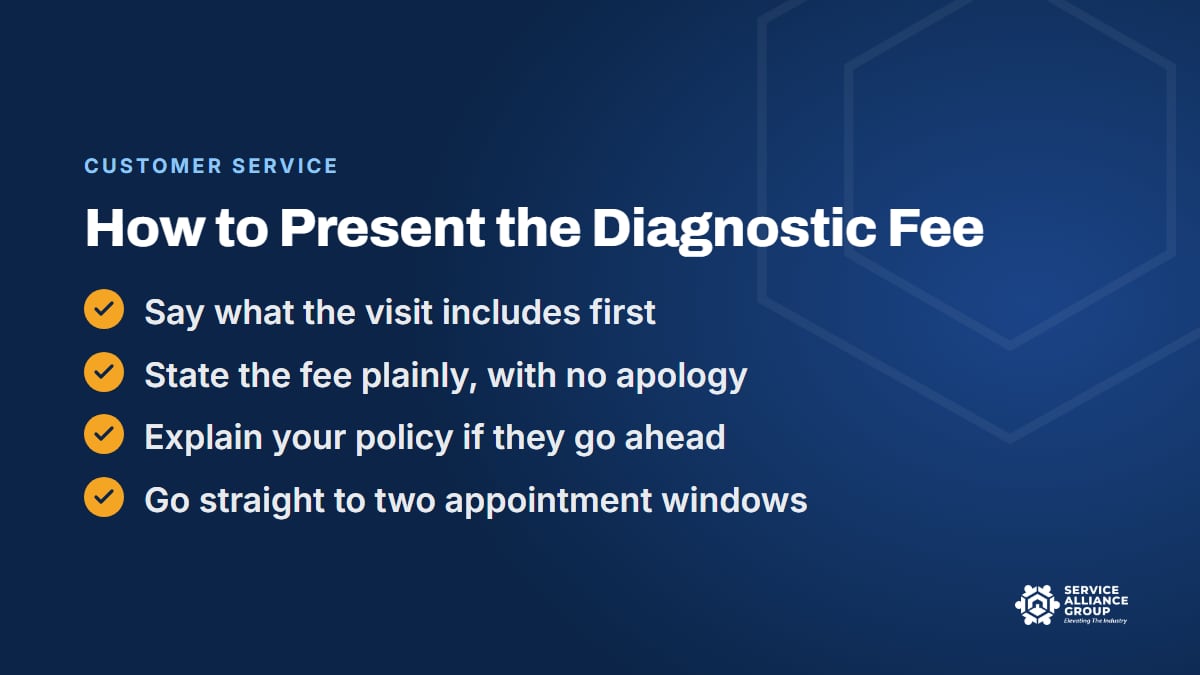
Your appliance repair CSR should present the fee on every call, before booking, in this order: what the customer gets, the number, your policy if they go ahead with the repair, and the appointment question.
"Our technician will come out, test the dryer, find what's causing the problem, and give you the price to fix it before any work starts. The diagnostic visit is [your fee], and if you go ahead with the repair, [your policy]. I have tomorrow between 8 and noon or Thursday between noon and 4. Which works better for you?"
That script never pauses after the number to wait for a reaction, and it never opens with "Unfortunately, there is a fee." A fee the customer heard and agreed to on the phone is much harder to argue about in the laundry room.
Confidence comes from knowing why the fee exists (the tech's time, the drive, the van, the test equipment, and years of learning to diagnose) and that it is priced right. Check yours against what an hour of your tech's time really costs with our free Cost of Doing Business calculator.
Then make your policy on applying the fee one rule, said the same way on every call. A CSR who improvises ("I think they usually take it off") hands the tech an argument and chips away at your booking rate.
Skill 6: Handle Price Questions, Objections, and Repair or Replace
A price question usually means the caller is nervous about a bill they cannot see yet. Your job is to make that unknown smaller without guessing.
"How much will it cost to fix?"
Do not guess. The same symptom can be a small part on one machine and a control board on another. Say what you can promise instead: "A dryer that won't heat can be a few different things, and I'd hate to guess wrong. The technician will find the cause and price the repair before doing any work, and you decide from there."
The objections you will hear every week
Script an answer for each of these, and practice them out loud until they sound natural:
- "That's a lot just to come out." "I understand. That covers a trained technician's time, the trip, and a real answer about what's wrong." Then state your fee policy and offer the two windows again.
- "Another company comes out for free." Never knock the competition: "I can't speak to how other companies price. With us, you know the cost of the visit up front, and nothing gets done until you say yes to the repair price."
- "I need to check with my spouse first." "Of course. I can pencil you in for tomorrow morning and text you the details. Just let me know by 3 today if it doesn't work."
- "I'm just calling around." Give them a reason to stop: your earliest window, what the visit includes, and your repair warranty if you offer one. Then ask for the booking anyway.
"Is it even worth fixing?"
Nobody on the phone can see the machine, so your appliance repair CSR should neither answer this nor dodge it. Collect the age, brand, and symptom for the tech, then set the expectation: "That's exactly what the technician will tell you. If it isn't worth fixing, they'll say so, and you'll know before you pay for a repair."
Put that way, the fee buys an honest answer to the caller's real question. Our free 5 Star Service Calls course covers the technician's side of that conversation.
Skill 7: Recap the Call and Send the Confirmation Text
A booked call is not finished until the customer knows what happens next. Before hanging up, your appliance repair CSR reads it back: "Maria, 214 Elm Street, the dishwasher that isn't draining, tomorrow between 8 and noon, and the diagnostic visit is [your fee]. Your technician will text when they're on the way. Anything else they should know before they get there?"
That last question catches the details that wreck a visit: the dog that slips out, the gate code, the washer that is actually in the basement. Put the answers in the job notes, along with anything the CSR promised.
Then send the confirmation text before the customer puts the phone down:
- Your company name and the appointment window
- The appliance and the problem, in a few words
- The diagnostic fee and your policy on applying it
- What to have ready: a clear path to the appliance, pets put away, and a photo of the model tag
- How to reschedule, so a conflict becomes a new time instead of a no-show
A reminder the day before and an on-my-way text from the tech finish the job. If your software cannot send those automatically, see our guide to appliance repair scheduling software.
Skill 8: Score Your Phone Calls and Track Your Booking Rate
You cannot coach phone calls you have never heard. Start with the booking rate: booked jobs divided by qualified calls. A qualified call is a customer in your service area, with an appliance you work on, who wanted a repair, so vendor calls and wrong numbers come out of the count.
For example, if 50 qualified calls came in last week and 34 booked, the booking rate was 68 percent, and 16 people who needed a repair hung up without an appointment. Those are the phone calls to listen to first. Track the booking rate weekly, by CSR and by lead source.
Listening to those calls later means recording them, and consent rules for recording vary by state. Before you start, check your state's rules with a qualified professional, and let everyone on a recorded call know it may be recorded, outbound calls included.
Then score recorded calls with yes-or-no lines that match this post:
- Answered fast, or called back within your standard
- Got the name and callback number early
- Collected the appliance, brand, model, symptom, and warranty status
- Caught any safety call and used the safety script first
- Presented the diagnostic fee clearly, without apologizing
- Answered price questions and objections without guessing
- Offered two windows and asked for the booking
- Recapped the call and sent the confirmation text
Past the checklist, listen for tone (does the CSR sound glad the customer called?), control (who is leading?), and the turn: the exact sentence where an unbooked call slipped away. Write a better line for that moment and add it to the script card. Have the CSR score each call before you share your score.
For a weekly routine that covers recordings and missed calls, see why it's important to monitor customer service.
Free Training for Your Appliance Repair CSR
Every skill in this post goes deeper in the free Appliance Repair CSR Course in our member portal. We built it for whoever answers your phone: a new hire, a longtime office manager, or you.
It is 8 modules and 29 short lessons, with demo calls, downloadable script cards, and a final exam. Beyond the eight skills here, it covers scheduling and texts, parts and payment, complaints and difficult callers, warranty and home warranty jobs, and outbound calls.
Your techs have a free course of their own, 5 Star Service Calls, for the visit itself. And to hear how other shops run their phones, ask in The Alliance, our free private Facebook group of more than 5,500 appliance repair business owners.
Frequently Asked Questions
Should an appliance repair CSR quote repair prices over the phone?
Not an exact repair price. A guessed number becomes a promise the technician has to break at the door. Quote the diagnostic fee, explain that the technician prices the repair after testing the appliance, and book the visit. If your shop runs flat rate and wants to share typical ranges for common repairs, put those ranges in writing from your price book so every CSR gives the same answer.
What should an appliance repair CSR do with an angry caller?
Let them finish without interrupting or defending the shop. Repeat the problem back so they know you heard it, apologize for the experience, and tell them exactly what happens next and by when. Leave decisions about refunds or a free return trip to the owner. Then write the call up, because an angry call can be the first warning of a problem the owner needs to fix.
I answer the phone myself between jobs. Where should I start?
With Skill 1. An owner under a dishwasher is going to miss calls, so set up an automatic text-back and return every missed call the moment you step away from the machine. Keep the fee script and the two-window close on a card in the van. When the phone rings more than you can answer well, your booking rate will show it, and it may be time for a CSR or an answering service that books.
How do I train a new appliance repair CSR?
Put the call flow and the fee script on a card, then role-play the common calls until the key lines sound natural: the dead dryer, the leaking washer, the price shopper, the gas smell. Have them listen to recorded calls before taking live ones, then score their first real phone calls together. The free Appliance Repair CSR Course adds demo calls, script cards, and a final exam for that first stretch.
Every call your shop paid for deserves someone on the phone who knows what to say. Pick one skill, practice it on this week's phone calls, and watch what it does to your booking rate.