
How to Start an Appliance Repair Business: 9 Essential Steps

You know the repair side. You can stand in a laundry room, listen to a dryer for ten seconds, and know it is a bearing before the customer finishes describing the noise. What nobody taught you is how to start an appliance repair business that pays you better than the shop you are leaving.
These are the nine steps to start an appliance repair business, in the order they matter: legal setup, insurance, the startup budget, the pricing math, tools, the van and parts vendors, first customers, phone coverage, and getting paid.
Some of these take an afternoon. Two of them, the budget and the pricing, will decide your income for years. Slow down on those.
Table of Contents
Steps 1 and 2: Make Your Appliance Repair Business Legal and Insured
Both of these feel like paperwork, and both of them protect the appliance repair business you build afterward. Do them before you print a business card.
Step 1: Choose a business structure and get licensed
When you start an appliance repair business, the common choices are a sole proprietorship or a single-member LLC, and some owners later ask their CPA whether S corporation tax treatment makes sense. Each choice changes your liability exposure, your taxes, and your paperwork. The U.S. Small Business Administration has a plain-language guide to choosing a business structure, and a CPA or attorney in your state can tell you which one fits your situation.
Once the structure is set, get an EIN, open a business checking account, and never run a personal expense through it. The IRS small business page covers the EIN and the tax basics a new owner needs.
Licensing is where a new appliance repair business gets tripped up, because the rules change from state to state and city to city. Depending on where you work, you may need a general business license, a state registration for appliance repair dealers, a contractor or specialty license for some kinds of work, or a mix of them.
Your state, and sometimes your city, also decides whether you collect sales tax on parts, labor, or both. Check your state and local requirements before you take money, use the SBA guide to licenses and permits as a starting checklist, and confirm the details with a qualified professional.
One requirement is federal. Anyone who works on the sealed refrigerant system of a refrigerator or freezer needs EPA Section 608 technician certification first, and Type I is the certification that covers small appliances such as household refrigerators and freezers. Refrigerator calls will come in whether you want them or not, so decide now whether you will get certified and take sealed system work or refer it to a shop that does.
Step 2: Get insured before the first call
You are working inside other people's homes, around water lines, gas lines, and hardwood floors. General liability insurance is the policy meant for claims like the dishwasher supply line that lets go after you leave, so read what yours covers and ask your agent about the gaps. No appliance repair business should run a single call without it.
Ask about commercial auto for the van, because a personal auto policy may not cover a vehicle used for business, and tool and equipment coverage so a break-in does not end the company. Workers' compensation rules depend on your state and how many people you employ, so check your state's requirements and ask your agent before the first employee starts. Property managers and home warranty companies often ask for a certificate of insurance before they send work, so keep one ready to email.
Steps 3 and 4: Build the Budget and Price From Your Cost of Doing Business
Here is where the money side of starting an appliance repair business gets decided. It is tempting to jump from the van straight to the first customer and back into the pricing later, usually after a slow month. Do it now, before a single price is printed anywhere.

Step 3: Write a startup budget you can live with
Split the budget into two lists. One-time costs: the van, shelving, lettering or a wrap, tools and meters, the first round of van stock, business formation fees, a basic website, uniforms, and the insurance down payment. Recurring costs: insurance, fuel, phone and software, parts purchases, a loan payment if you financed the van, and your own paycheck. The SBA has a worksheet for calculating startup costs that keeps you honest about both lists.
Then add a cash reserve. A new appliance repair business rarely has a full schedule the week its Google Business Profile goes live, and parts orders tie up money before the customer pays the balance. Plan for several months of business and household expenses in the bank, and treat that reserve as part of the startup cost rather than a nice-to-have.
Buy used wherever it makes no difference to the work. A cargo van that already has shelving does the same job as a new one, and the savings go further in meters and stock than in a lower odometer.
Step 4: Set your diagnostic fee and parts markup
Every price in an appliance repair business should come from one number: your cost of doing business per hour. Add up every recurring cost except the parts you resell on jobs, include the paycheck you need to take home, and divide by the hours you can actually bill. A solo tech who works 40 hours does not bill 40, because drive time, parts runs, phone calls, and paperwork all come out of the week. Track your own billable hours for a few weeks instead of guessing.
Here is the math with example numbers only. Say your costs plus your paycheck come to $9,000 for the month and you bill 100 hours that month, about 23 a week. Your cost of doing business is $90 per billable hour. Add the profit you want on top, say 20 percent, and your labor needs to bring in $108 for every hour you bill. Put your own numbers into our free Cost of Doing Business calculator to find your real figure.
The diagnostic fee comes out of that number. A diagnostic visit can take an hour or more of your day once you count the drive. With the example numbers above, that hour costs you $90 before profit and $108 with it, so a fee that covers a few minutes of your time loses money on every call that does not turn into a repair.
Set the fee to cover the trip and the diagnosis, decide up front whether it applies toward the repair, and use the same rule on every call so the person answering the phone can state it with confidence.
Parts markup works best in tiers, with a higher percentage on inexpensive parts and a lower one on expensive parts. For example, a 50 percent markup adds $6 to a $12 part, which does not pay for the time to look it up, order it, and pick it up. The same 50 percent adds $150 to a $300 control board. Write the tiers down once and the markup stops being a judgment call at the kitchen table.
Steps 5 and 6: Tools, the Van, and Parts Vendors for Your Appliance Repair Business
You already own a lot of what you need. The goal here is to fill the gaps that cost you a second trip, and to avoid spending on things that ride around unused.
Step 5: Buy the tools and diagnostic equipment that earn their keep
Buy first the tools you will reach for most: a quality multimeter with a clamp ammeter, a manometer for gas appliances, temperature probes, a good driver and socket set, an appliance dolly and straps, and floor protection (booties, drop cloths, and mats that go down before the machine moves). If you get certified for sealed system work, budget for the recovery equipment and other gear that work calls for. Keep a written tool inventory with serial numbers for the insurance claim you hope never to file.
Information is a tool too. The service manual and tech sheet for the exact model in front of you can be the difference between a confirmed diagnosis and a guess that costs a wrong part and a return visit. Appliance Atlas gives you AI troubleshooting grounded in a library of 131,000+ service manuals, built for a phone in the field. It answers from the documentation for that model and confirms the OEM part number against a live wholesale catalog, with price and stock, before you order.
Step 6: Stock the van and open parts accounts
Do not fill the van from a guess. Start with a small stock of the parts that fail most often on the brands and appliance types you plan to service, then let your job history tell you what to add. Every part you carry is cash sitting on a shelf, and dead stock is one of the quietest ways a new appliance repair business bleeds money. Our guide to inventory management and van stock covers minimums, maximums, and a weekly restock routine.
Open accounts with at least two parts distributors before you need them. Ask each one about return policies and restocking fees, core charges, warranty parts, delivery and will-call options, and when they extend net terms. Knowing those rules on day one keeps a wrong part from turning into a loss, and keeps you from ordering blind on a Friday afternoon.
Set the van up so a part takes seconds to find: shelving, labeled bins, and a standing rule that nothing rides loose. Lettering on the van is some of the cheapest marketing an appliance repair business can buy, so put the company name, the phone number, and the words "appliance repair" where a neighbor can read them from the curb.
Steps 7 and 8: Get Found and Answer the Phone
Marketing for a new appliance repair business is simpler than it looks, and most of it costs time rather than money. The two jobs are to be the appliance repair business people find when they search, and to be the one that picks up when they call.
Step 7: Set up your Google Business Profile and find first customers
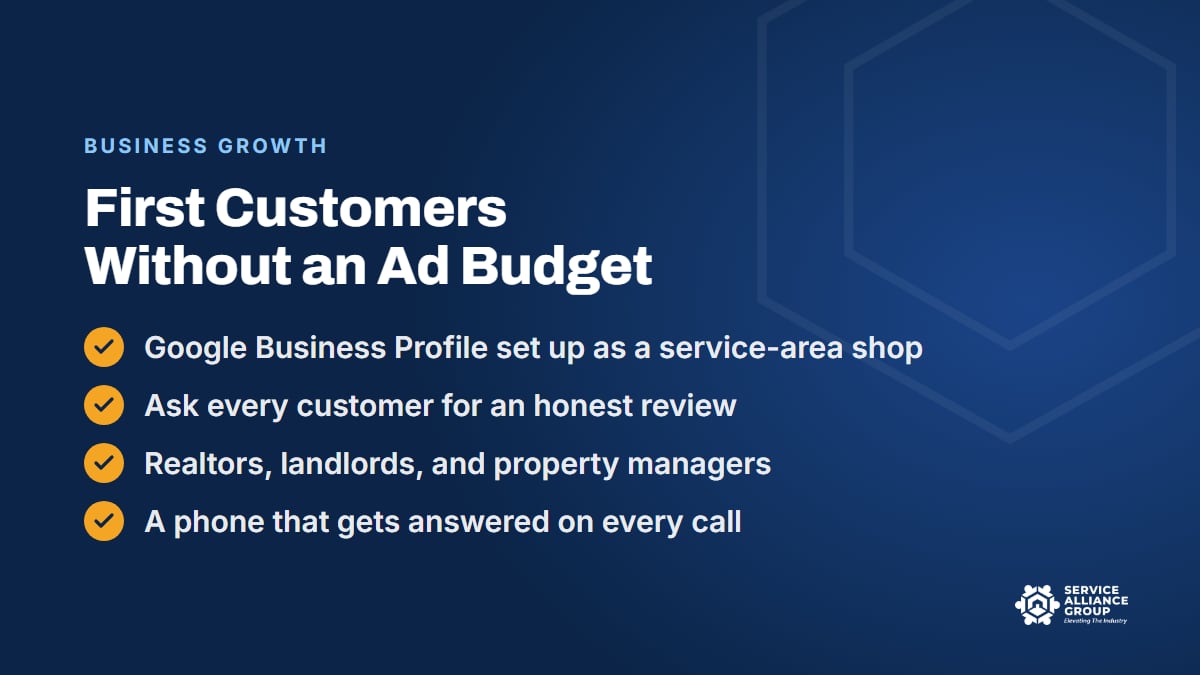
For a new shop, your Google Business Profile can bring in calls long before your website does, so set it up right. Use your real business name with no added keywords or cities. If customers do not come to your address, set it up as a service-area business: hide the address and list the area you actually serve.
Choose the appliance repair category, fill in services, hours, and photos of you and the van, and ask every customer for an honest review. Google's rules are clear: no money, discounts, or gifts in exchange for a review, and no picking which customers get asked.
A simple website with your phone number, service area, the brands you service, and an honest explanation of your diagnostic fee finishes the job. Our guides to marketing an appliance repair business without spending a fortune and service area business SEO go deeper on both.
First customers for an appliance repair business usually come from people who already know you: friends, neighbors, customers who ask for you by name, realtors, small landlords, property managers, and used appliance dealers who need a repair partner. If you signed a non-compete or non-solicitation agreement at your last job, have an attorney review it before you reach out to anyone.
Home warranty companies can fill a slow calendar, but they set the rates and the payment timelines, so run the math before you lean on them. In Nextdoor and local Facebook groups, answering questions will do more for you than posting ads.
Step 8: Cover the phone from day one
A tech under a dryer cannot answer the phone, and a call that goes to voicemail is often a call to the next appliance repair business on the list. Decide who answers before the first call comes in: an answering service, a part-time CSR working from home, a family member with a script, or call forwarding with a text-back that promises a callback within minutes.
Use a business number you own and can move, not your personal cell, so you can hand it to a CSR later without losing your customers. Whoever answers needs to know the service area, the brands, the diagnostic fee, and how to book. The free Appliance Repair CSR Course in our member portal covers the call flow, qualifying, and presenting the fee in 8 modules and 29 short lessons, with demo calls and downloadable script cards.
Step 9: Get Paid on Every Job
Cash keeps a young appliance repair business alive, and collecting it should never depend on a conversation at the door. Set your payment rules once and apply them on every call.
Collect the diagnostic fee at the visit, every time, with a card reader on your phone so nobody has to find a checkbook. When a repair needs a part on order, take a deposit that covers the part cost before you order it. Present the repair price before the work, in writing, with the customer's yes on the invoice. Property managers and warranty companies pay on their own terms, so know each one's schedule and invoice them the same day the job closes.
Behind the scenes, use bookkeeping software from the first week, reconcile the bank account every month, and set money aside for taxes as it comes in instead of hunting for it in April. Your CPA can tell you how much to set aside for your structure and your state, and whether you should make estimated tax payments during the year.
Mistakes That Sink a New Appliance Repair Business
Here are the mistakes we would warn a new appliance repair business owner about first. Every one of them is easier to avoid when starting an appliance repair business than to fix a year in.
- Pricing off the competitor's website. Their numbers are not built on your costs. They may be losing money too.
- Waiving the diagnostic fee to win the job. The visit cost you the drive and the time either way. Apply it toward the repair if you like, but never send it to zero.
- Taking every brand and every job. An appliance repair business that does everything is slow at everything. Pick the appliance types and brands you know, stock for them, and refer out the rest until you are ready.
- Not tracking numbers from week one. Calls, booked calls, completed jobs, average ticket, and parts margin. Five numbers, every Friday, on one sheet.

Start Right With the S.O.S. Course
Much of this guide follows the Start stage of The S.O.S. Course (Start, Operate, Scale). It is one course in three stages you work in order, so a technician getting ready to start an appliance repair business begins with Start, which covers legal setup, the pricing math, tools and the van, and first customers.
Across all three stages there are 70 lessons and more than 21 hours of business training, plus 70 downloadable tools, including 12 live spreadsheets that do the math for you. Each stage ends with a quiz, and the course ends with a master test and a certificate of completion. You can see the course in the member portal.
If you want a place to ask questions along the way, The Alliance, our free private Facebook group, has more than 5,500 appliance repair business owners in it.
Frequently Asked Questions
Do I need a license to start an appliance repair business?
It depends on where you work. You may need a general business license, a state registration for appliance repair dealers, a contractor or specialty license, or a combination. At the federal level, anyone who works on the sealed refrigerant system of a refrigerator or freezer needs EPA Section 608 certification. Check your state and local requirements and talk to a qualified professional before you take your first call.
How much does it cost to start an appliance repair business?
There is no single number for starting an appliance repair business. The van is usually the biggest purchase, and choosing a good used one over a new one can move the total more than any other decision. Build your own budget in two lists, one-time costs and recurring costs, then add a cash reserve for the months before calls are steady. The SBA startup cost worksheet linked above helps you organize both lists, and your real total will come from your own quotes.
Should a new appliance repair business charge a diagnostic fee from day one?
Yes. The diagnostic visit costs you the drive, the time, and the expertise whether or not the customer says yes to the repair, and a fee built from your cost of doing business keeps that visit from losing money. Decide up front whether it applies toward the repair, put the rule in the phone script, and apply it the same way on every call.
Can I start an appliance repair business part-time while I keep my job?
Some owners do, starting with evening and weekend calls. Read your employment agreement first, and have an attorney look at any non-compete or conflict-of-interest terms. The pieces that cannot wait are insurance, a business bank account, and a real plan for the phone, because customers call during the day whether you are free or not. Treat the part-time stretch as a test of your pricing and call volume, and use the numbers to decide when the appliance repair business can carry you full-time.
You already have the skill. Take the nine steps in order, price from your own numbers, and the appliance repair business you start will hold up under the work.