12 Benefits of Standard Operating Procedures for Appliance Repair Businesses

Standard operating procedures are the difference between a shop that runs on your memory and a business that runs without you in the building. A young appliance repair company usually starts as the first kind. The owner knows how parts get ordered, how the diagnostic fee gets presented, and what to do when a customer calls back, because the owner is the one doing all of it.
That works until the second van. Picture a new tech ordering the wrong part, a CSR quoting a fee the owner never agreed to, and a callback sitting for four days because nobody was sure whose job it was. Nobody in that picture was careless. There was simply nothing written down to follow.
Here are twelve benefits of writing it down, grouped by what they do for the work, the people, the risk, and the growth of the business, followed by how to start.
Table of Contents
What Standard Operating Procedures Are in an Appliance Repair Shop
A standard operating procedure is a written, step-by-step description of how your shop does one specific thing. How a call gets booked. How a part gets ordered, staged, and installed on the second visit. How a callback gets scheduled and what the customer is charged. How the van gets restocked on Friday.
That is different from a policy, which says what the rule is, and from a checklist, which is the short version a tech runs from the driveway. A good SOP usually contains both: the rule and the reason at the top, the steps in the middle, and the checklist at the bottom.
In this trade, the procedures that matter most cluster around the two-visit job: the diagnostic, the part on order, the return trip, the invoice, and the review request. Get those five on paper and a lot of the daily chaos has a document behind it.
Benefits 1 to 3: The Work Gets Done the Same Way Every Time
The first group of benefits shows up on the job, where the customer can see it.
1. Consistency across every tech and every call
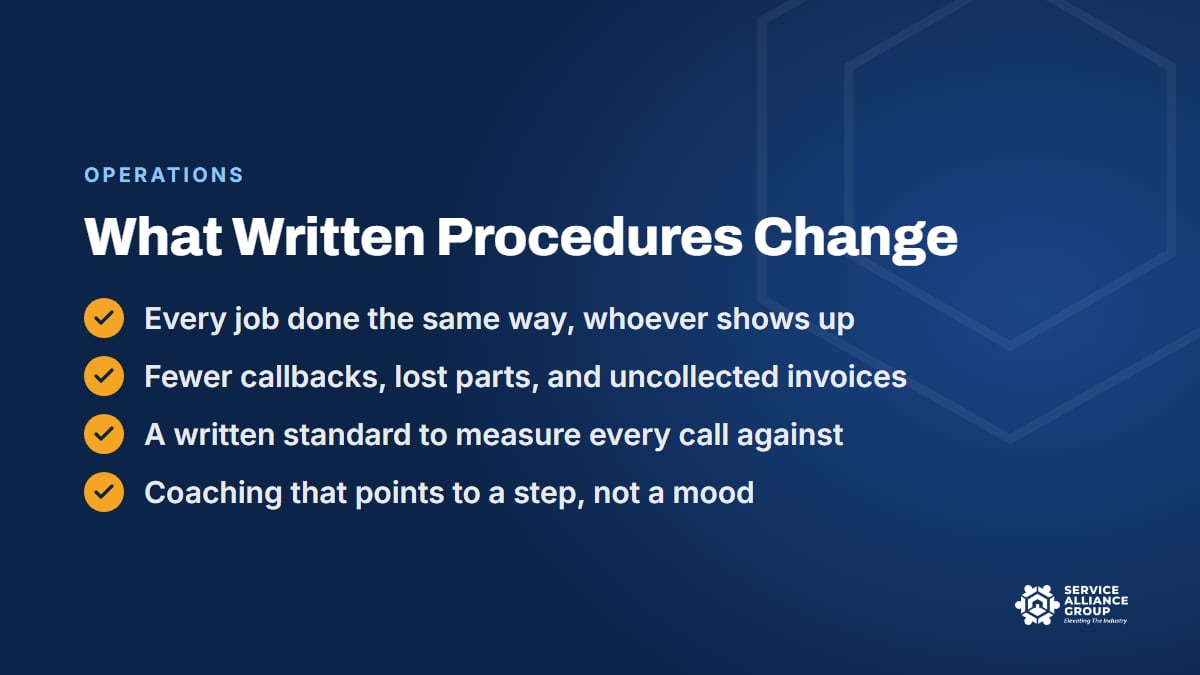
Without written procedures, your shop has as many ways of doing things as it has technicians. One tech texts an on-my-way message and one does not. One collects the diagnostic fee before the repair and one forgets. One leaves the laundry room cleaner than they found it and one leaves lint on the floor.
Standard operating procedures replace "how each tech happens to do it" with "how we do it here." The customer gets the same experience whether the senior tech or the new hire shows up, and you stop fielding calls that start with "the tech who came last time did it differently."
2. Fewer mistakes, callbacks, and lost parts
A lot of expensive mistakes in a repair shop are process mistakes: the part number confirmed from memory, the second visit never booked, the invoice that went out without the trip charge. Each one costs a return trip or a write-off.
A written procedure puts the check in the process instead of relying on someone to remember it. Confirm the part number before ordering. Book the second visit before leaving the driveway. Collect the diagnostic fee at the point your policy sets. If you are working on your first-time completion numbers, our guide to improving first-time complete rates pairs well with a parts SOP.
3. Quality you can measure
You cannot measure against a standard that does not exist. Once the service call procedure says the tech sends the on-my-way text, protects the floor, and asks every customer for a review, you can check whether it happened. Ride-alongs, callback reviews, and customer complaints all get compared against the document instead of against your mood that day.
That also makes coaching fair. "You skipped step six" is a conversation. "You did it wrong" is an argument.
Benefits 4 to 6: Your People Get Better, Faster
The second group is about the crew, and about getting your own time back.
4. Faster training for new hires
A new tech in a shop with no written procedures learns by shadowing whoever is free that week, which means they learn that tech's habits, shortcuts, and blind spots. Training takes longer and the result depends on who they rode with.
With standard operating procedures, a new hire reads how the shop books a call, orders a part, and closes an invoice, then rides along to see it done the same way. Onboarding gets shorter and more predictable. It also takes less of your best tech's time, because the document does some of the explaining.
5. Easier hiring
When everything lives in your head, you are forced to hire someone who already knows everything, and those people are rare and expensive. When the procedures are written, you can hire for attitude and mechanical aptitude and teach the rest.
Written procedures also make the job description honest. The listing can say exactly how the shop runs, the interview can walk through a real SOP, and the new hire signs off on the procedures during onboarding. The U.S. Small Business Administration's page on hiring and managing employees covers the paperwork side of bringing someone on.
6. Easier delegation
A lot of owners hold onto tasks for a simple reason: nobody else knows how to do them. Parts ordering, callback scheduling, review requests, van stock counts. Each one stays on your desk because handing it off would take longer than doing it.
An SOP is the handoff. Once the procedure is written and tested, you can give parts ordering to the office manager and van stock to the lead tech, and check the spreadsheet instead of doing the work. That is how an owner gets out of the van for good.
Benefits 7 to 9: The Business Is Protected
The third group is about risk: what happens when someone leaves, gets hurt, or burns out, including you.
7. Protection against key-person risk
Every process that exists only in one person's memory stops when that person does. That includes you. If you are out for two weeks with a back injury, parts still need ordering, second visits still need booking, and invoices still need collecting. If your office manager quits on a Friday, someone else has to know how callbacks get scheduled by Monday.
Standard operating procedures are insurance against the week you are not there. They are also insurance against the tech who knows the whole parts process leaving for a competitor and taking that knowledge along.
8. Liability and safety
Appliance techs work around 240-volt circuits, gas connections, sealed refrigeration systems, and heavy machines on wet floors. A written safety procedure that every tech has been trained on and signed helps keep people from getting hurt, and it gives you a record of that training if someone does. OSHA publishes free guidance for small employers, and a safety SOP is how that guidance gets into the van.
Compliance procedures matter too. Technicians who service or dispose of appliances that contain refrigerant need EPA Section 608 certification, and Type I covers small appliances such as household refrigerators and freezers. A procedure that tracks who is certified and where the records live helps you keep that straight. As with anything legal, check your state and local requirements and talk to a qualified professional about your specific situation.
9. Less owner stress
This one is hard to put on a spreadsheet, but you feel it. When the procedures are written, fewer calls come to you asking how something is done. Techs check the document before they call you. The office knows what to do with a home warranty job without asking. You stop being the answer to every question, and you can leave the building.
Benefits 10 to 12: The Business Can Grow and Is Worth More
The last group is about growth: happier customers, more trucks, and one day a sale.
10. A better customer experience
Customers never see your standard operating procedures, but they feel them. The on-my-way text arrives. The tech protects the floor. The office calls when the part arrives instead of the customer calling to ask. The review request comes the same evening, every time.
Every one of those is a step in an SOP, and they are hard to deliver every time without one. A five-star review is often describing exactly that kind of consistency.
11. Scalability: adding a van without adding chaos
Growth breaks whatever was held together by the owner's attention. Add a third van, and dispatch can start to slip, parts can pile up on the shelf, and callbacks can fall between two people who each thought the other had it.
Standard operating procedures let you add a tech, a CSR, or a second office person without reinventing the shop. The new person reads the dispatch procedure, and the dispatch procedure does not change because someone new is following it. Our post on effective dispatching strategies covers what a good dispatch process looks like.
12. A higher business value when you sell
Vans and equipment count when you sell, but a buyer also wants to know whether the business keeps producing after you leave. A shop that runs on the owner's memory is harder to hand over, and documented procedures are part of how you show a buyer the work does not walk out the door with you. A business broker, CPA, or attorney can tell you what matters most for a sale in your situation.
If an exit is anywhere on your horizon, our posts on building a service business worth buying and whether to sell your business go deeper. The Scale stage of the S.O.S. Course covers valuation and exit options.
How to Start Writing Standard Operating Procedures This Month
Trying to document everything at once tends to leave you with nothing finished. Start with one.
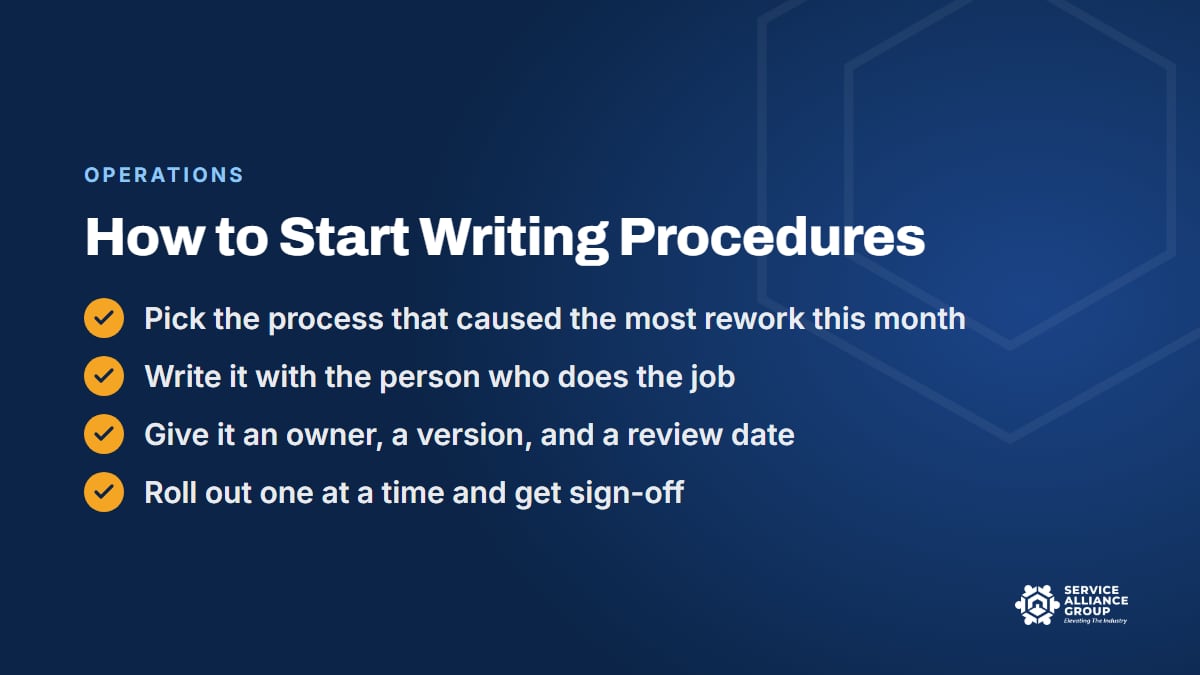
- Pick the process that caused the most rework this month. It is often dispatch or parts. If you are not sure, look at last month's callbacks and ask what a document would have prevented.
- Write it with the person who does the job. The owner sets the standard; the tech or CSR who does it every day makes it true. Watch them run the task from the draft and fix every place they stall.
- Keep it to one page. Purpose, scope, owner, numbered steps, a checklist, and a version number. If it runs longer, it is probably two procedures.
- Give it an owner, a version, and a review date. Track all three in a master spreadsheet so you can tell what is live and what is overdue.
- Roll out one at a time and get sign-off. Walk it through at the next meeting, have everyone sign and date it, and set an effective date. Then start the next one.
One SOP that gets used beats twenty that sit in a folder. A pre-service checklist is a good candidate for the first one, because it gets used before every call.
Skip the Blank Page: Start With the SOP Library
The SOP Library gives you a head start. It is the largest SOP and document library ever built for the appliance repair industry: 159 editable documents in 13 categories, including Operations, Customer Service, Parts and Warranty, Finance and Pricing, Hiring and Recruiting, HR Policies, and Safety and Compliance.
You download a document, drop in your company name, adjust it to how your shop actually runs, and put it in front of your team. The library is sold on its own at members.servicealliancegroup.com/library or included with monthly All-Access, and the SOP Library page has the overview.
If you want the method along with the material, Build Your SOP System is the 15-lesson companion course: deciding which procedures you need, folder structure, the master spreadsheet, SOP and document templates, writing your first SOP, tools, using our templates, distribution and approval, and getting staff to follow them.
Frequently Asked Questions
What is the difference between standard operating procedures and a policy?
A policy states the rule, such as "every customer pays the diagnostic fee before the repair starts." A standard operating procedure describes how the rule gets carried out step by step: when the tech presents the fee, how it is collected, what happens if the customer declines, and how it is recorded. Policies belong in the handbook. Procedures belong in the hands of the person doing the job.
How many SOPs does an appliance repair shop need?
Start with the handful that cover the two-visit job: phone intake, dispatch, the service call, parts and the second visit, callbacks, and payment collection. Those six touch nearly every job you run. After that, add procedures as problems show up, and add HR, safety, and hiring documents before the crew grows past what you can manage by memory.
Will my techs actually follow written procedures?
Techs are far more likely to follow procedures they helped write and were trained on than ones emailed on a Sunday and never mentioned again. Test each SOP with the person who does the job, walk it through at a meeting, get a signature, and make the document the standard when something goes wrong. Following it becomes the easy path.
Do standard operating procedures help a one-person shop?
Yes, in two ways. Writing down how you order parts or collect payment forces you to fix the sloppy version you have been living with. And the day you hire your first tech, the procedures are already there, so training starts from a document instead of from scratch. The best time to write them is before you need them.
Pick one procedure this week, write it on a page with the person who does it, and get it signed. The other eleven benefits follow from that one habit.