How to Write Appliance Repair SOPs Your Team Will Actually Follow

Appliance repair SOPs are easy to write and just as easy to ignore. The ones that get followed come down to four decisions: what you write first, how you format it, who tests it, and who keeps it current.
Below are seven ways to write standard operating procedures your crew will use on a Tuesday when you are not in the building, starting with which seven appliance repair SOPs to write first.
Table of Contents
Why Appliance Repair SOPs End Up in a Drawer
Picture an owner who gets burned by a callback or a lost part, sits down on a Sunday, and writes ten pages on how things should be done. The document gets emailed to everyone, nobody reads it, and the next lost part happens the same way.
When appliance repair SOPs get ignored, it usually traces back to four problems. They describe the ideal process instead of the real one. They are too long to use on a phone in a laundry room. Nobody who does the job helped write them. And they have no owner, so the first time the dispatch software changes, the document is wrong and stays wrong.
Every step below is built to head off one of those four problems.
1. Start With the Seven Appliance Repair SOPs That Break Most
You do not need a procedure for everything. You need one for whatever costs you the most rework, and in an appliance repair shop the same seven areas tend to come up first.
- Dispatch and scheduling. How a booked call becomes a slot on the board: time windows, route density, what gets moved when a job runs long, and who tells the customer.
- Parts ordering and the second visit. Who confirms the part number, who orders, when the customer hears, where the part is staged, and how the return trip gets booked.
- Callbacks. Who takes the call, how fast it gets scheduled, what the customer is charged (your policy, written down), and who reviews the original job.
- Payment collection. When the diagnostic fee is collected, which payment types you take, what the tech does when the customer cannot pay, and how the office follows up.
- Van stock and restocking. The minimum and maximum for each bin, who counts, when, and how a used part gets replaced before the next call needs it.
- Phone intake and booking. What the CSR asks, how the fee is presented, and what gets typed into the job so the tech is not starting from zero at the door. If the person on your phone needs the training first, the free Appliance Repair CSR Course covers the whole call.
- The service call itself. The on-my-way message, floor protection, the customer interview, options instead of one price, the invoice, and asking every customer for a review. The free 5 Star Service Calls course covers the customer side of that visit, from the on-my-way message to asking for the review.
Write the one that hurt most last week first. Then the next. Seven is a starting list, and nobody needs all seven appliance repair SOPs finished by Friday.
2. Set Up a Folder Structure and a Master Spreadsheet
Before you write anything, decide where it lives. A procedure nobody can find is the same as no procedure.
Keep it simple. Appliance repair SOPs belong in one shared folder your whole team can open from a phone, with a subfolder per area: operations, customer service, parts and warranty, finance and pricing, hiring and recruiting, HR policies, safety and compliance, and marketing. Those match several of the categories in our SOP Library on purpose. They mirror how a shop actually runs, so a tech looking for the parts procedure does not have to guess.
Then build the master spreadsheet. One row per document, with:
- Name and a short code (OPS-02 Parts Ordering)
- Category and where the file lives
- Owner (one name, never a department)
- Version number and the date it went live
- Status: draft, testing, live, retired
- Next review date
The spreadsheet is what turns a pile of documents into a system. It answers "do we have a procedure for that?" in ten seconds, and it tells you which SOPs are overdue for a look.
3. Use One Simple Standard Operating Procedure Template
All of your appliance repair SOPs should look the same, so a tech who has read one knows how to read all of them. Six fields are enough.
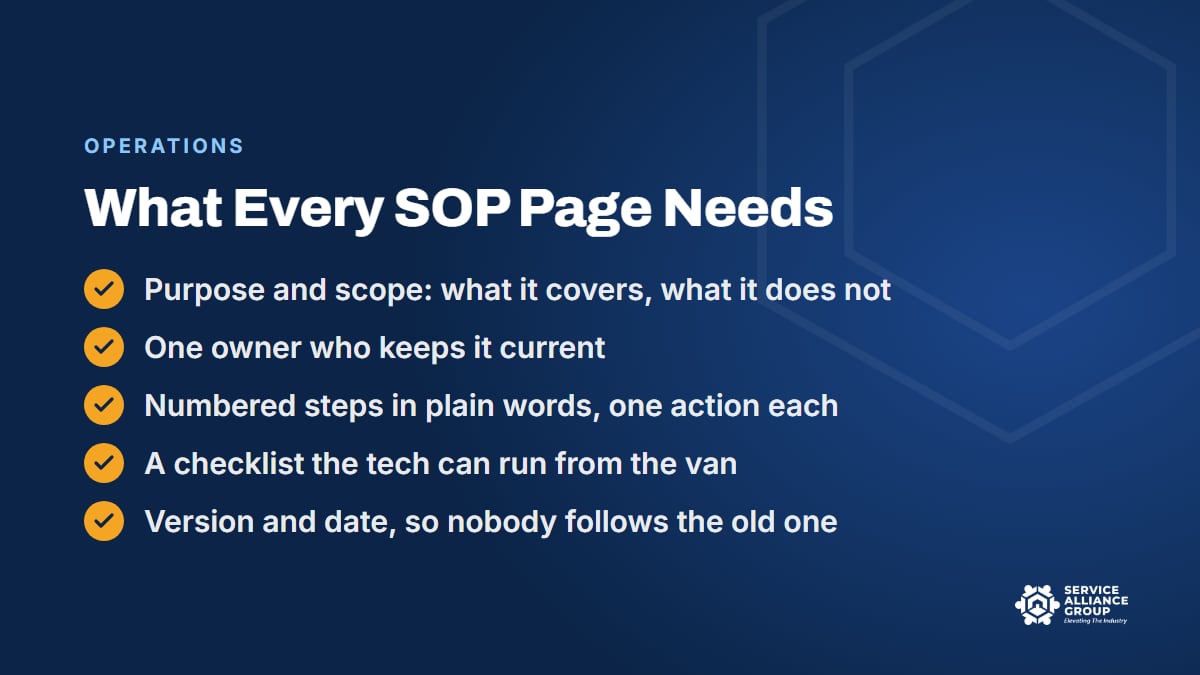
- Purpose. One sentence on why this exists. "So no part sits on the shelf without a second visit booked."
- Scope. What it covers and what it does not. "All parts ordered for residential jobs. Home warranty parts are covered in PW-01."
- Owner. The one person who keeps it current.
- Steps. Numbered, one action each, in the order they happen.
- Checklist. The short version the tech runs from the van.
- Version and date. So nobody follows the old one.
Here is what the top of a parts procedure might look like, filled in as an example:
OPS-02 Parts Ordering and the Second Visit (v1.2, live 10/01/2026)
Purpose: Every part ordered gets a customer update, a staging spot, and a booked return visit within one business day.
Scope: Parts for residential repairs. Home warranty jobs follow PW-01.
Owner: Office manager.
The steps follow underneath, then the checklist. The whole thing fits on one page, and the checklist alone fits on a phone screen. That is the target for every standard operating procedure you write.
4. Write in Plain Steps and Add Photos Where They Help
Write your SOPs for the newest person on the crew, the one who has never seen your parts shelf. Steps that work look like this:
- Start each step with a verb. "Open the job in the dispatch app. Tap Parts. Enter the part number from the tech's notes."
- Name the real tool, screen, supplier, and shelf. "The gray rack by the back door" beats "the staging area."
- Say who does it and by when. "Office, same day" or "Tech, before leaving the driveway."
- Cut "should," "generally," and "as needed." If it matters, say exactly what to do. If it does not, cut the step.
Add a photo when the words get long: the labeled bins in a well-stocked van, the parts shelf with the job ticket taped to the box, the exact screen where the second visit gets booked. A photo of the right way saves three paragraphs describing it.
Keep the whole thing to one or two pages. If it runs longer, you have two procedures pretending to be one. Split it.
5. Test It With the Person Who Does the Job
This is the easiest step to skip, and it decides whether your SOPs get followed.
Hand the draft to the tech or CSR who does that work every day. Ask them to do the task using only the document, while you watch and keep quiet. Every place they stall, ask a question, or do something the document does not say is a line you need to fix. Then ask the harder question: "Is this how it actually happens, or how I think it happens?"
Expect surprises. Maybe the parts shelf is not where you thought. Maybe the CSR already texts the customer a photo of the part when it arrives, and it works, so it goes in the SOP. Maybe the tech skips step four because it takes ten minutes while the customer stands there watching.
That conversation does two things. It makes the document true, and it makes the person who follows it a co-author. People follow what they helped build, and they quietly ignore what was handed down.
6. Roll It Out and Get Sign-Off
A finished SOP is not live until the team has seen it, asked their questions, and signed it.
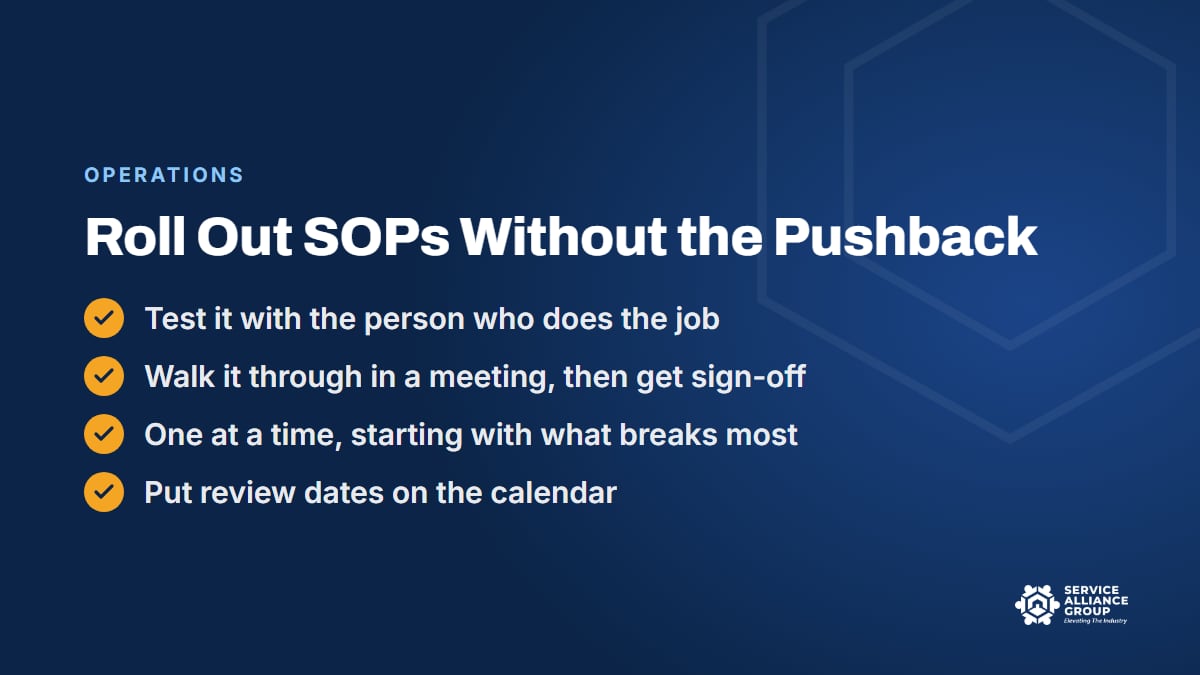
- Put the final version in the shared folder and retire the draft.
- Walk through it at the next meeting. Ten minutes, the owner of the SOP presenting, questions answered on the spot.
- Have everyone sign and date a sign-off sheet that names the version number. New hires sign during onboarding.
- Set an effective date. From that date, the SOP is the standard, and when a callback happens the first question is "did we follow OPS-02?" rather than "whose fault is it?"
Sign-off matters more than it looks. It turns "I didn't know" into a conversation about the document instead of an argument about memory. HR and safety SOPs deserve extra care, because they touch employment law and workplace safety rules. The U.S. Small Business Administration's guide to hiring and managing employees covers the employer basics, and OSHA covers workplace safety. Check your state and local requirements, and have a qualified professional review HR and safety documents before they go live.
7. Keep Your Standard Operating Procedures Current
An SOP that is wrong is worse than no SOP, because people follow it. Three habits keep appliance repair SOPs current.
- A review date on every document. Ninety days for anything new, then twice a year. The master spreadsheet tracks it.
- Change triggers. New dispatch software, a new supplier, a price change, or a callback that showed a gap: any of those means the owner opens the SOP that week, not someday.
- Version numbers, and only one live copy. When v1.3 goes up, v1.2 comes down. Mixed versions on the vans cause exactly the confusion you wrote the document to prevent.
A fifteen-minute review at the start of each quarter, walking the spreadsheet top to bottom, keeps the whole set alive. Owners who skip it end up with a folder of history instead of a set of SOPs.
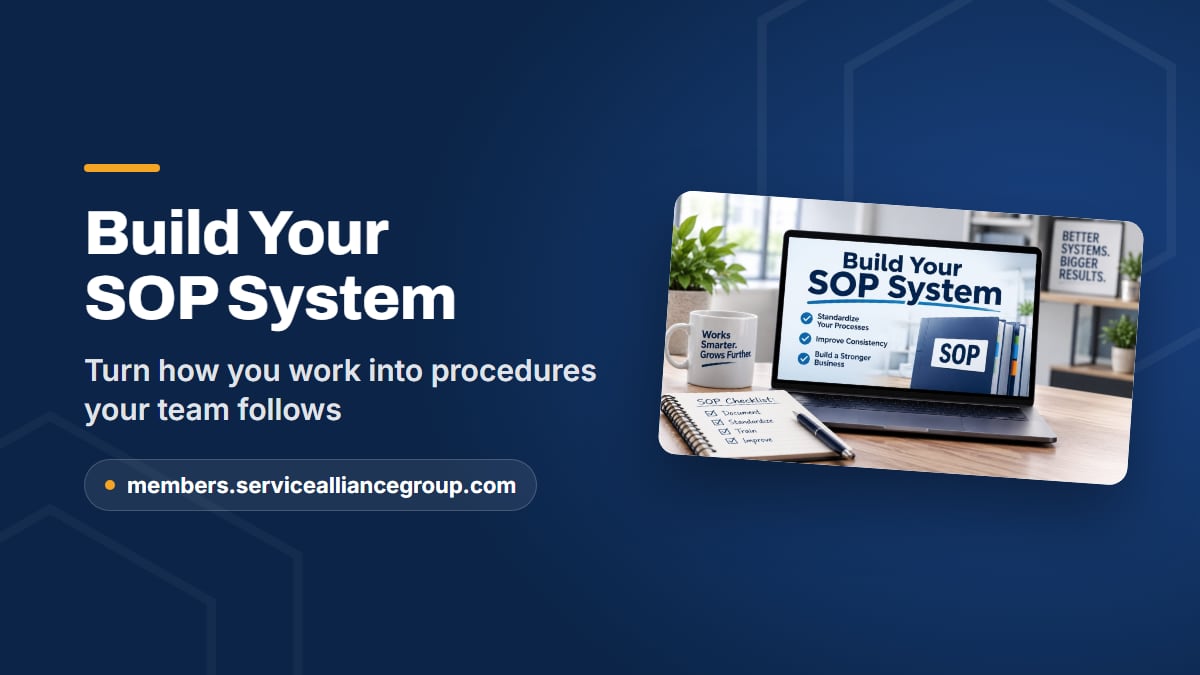
Build Your SOP System and the SOP Library
For a guided version, Build Your SOP System is the 15-lesson course in the member portal. It walks through deciding which procedures you need, folder structure, the master spreadsheet, SOP and document templates, writing your first SOP, tools, using our templates, distribution and approval, and getting staff to follow them.
Then there is the shortcut. Our new and improved SOP Library has been completely updated and revamped with newer, more up-to-date SOPs and business documents, and it is the largest SOP and document library ever built for the appliance repair industry. It holds 159 editable documents in 13 categories, including Operations, Customer Service, Parts and Warranty, and Finance and Pricing, the same areas most of the SOPs above fall into.
Instead of a blank page, you download a document from the right category, drop in your company name, and adjust it to your shop. Then you still test it with the person who does the job, because a template that was never tested is just a nicer-looking draft. See what is inside the SOP Library or go straight to the SOP Library page. It is sold on its own or included with monthly All-Access.
Frequently Asked Questions
How long should appliance repair SOPs be?
One page is the target, two is the limit. When a draft runs longer, look for a second procedure hiding inside it, such as parts ordering and parts returns, or dispatch and customer notifications, and split them. A tech reading it on a phone in a laundry room should find the step they need without scrolling through a wall of text.
Who should write the SOPs, the owner or the team?
Both. The owner decides what the standard is and writes the first draft, because the owner carries the risk. The person who does the job every day tests it and fixes what is not true. That test is where a document stops being the owner's opinion and starts being how the shop works.
How many SOPs does a small shop really need?
Fewer than you think to start, and more than you think over time. Begin with the seven that cause the most rework: dispatch, parts and the second visit, callbacks, payment collection, van stock, phone intake, and the service call. Once those are live and followed, add procedures as problems show up. Those first seven touch almost every job you run, which is why they come first.
What is the difference between an SOP and a checklist?
An SOP explains the whole procedure: why it exists, who owns it, and every step in order. A checklist is the short version the tech runs from the van without reading the explanation. The best standard operating procedure has both: the full steps for training, and the checklist for the tenth time you have done it.
Pick the procedure that cost you the most last week, write it on one page, and hand it to the person who does the job. That is the whole method. The rest is repetition.