
Appliance Repair Pricing: 6 Proven Rules for Profitable Jobs

A lot of appliance repair pricing is inherited. The owner priced off the shop they left, or off a competitor's website, or off what felt fair at the kitchen table in year one, and the numbers have been nudged up a little every so often since. Nobody ever built them from the actual cost of running the truck.
That is how a shop ends up booked solid with nothing left at the end of the month. These six appliance repair pricing rules fix it. They start with your cost of doing business and work outward to the diagnostic fee, the labor rate, parts markup, the second visit, home warranty work, discounts, and the yearly review that keeps all of it current.
Every dollar figure in this post is an example. Your prices come from your costs, not ours.
Table of Contents
Rule 1: Appliance Repair Pricing Starts With Your Cost of Doing Business
Your cost of doing business is what one billable hour costs you before you earn a dime of profit. Add up every cost of running the shop for a month: your paycheck, tech wages with payroll taxes and workers' comp, insurance, fuel, vehicle payments and maintenance, phone and software, rent or the garage, advertising, tools, bookkeeping, and the parts you end up eating. Then divide by the number of hours you can actually bill.
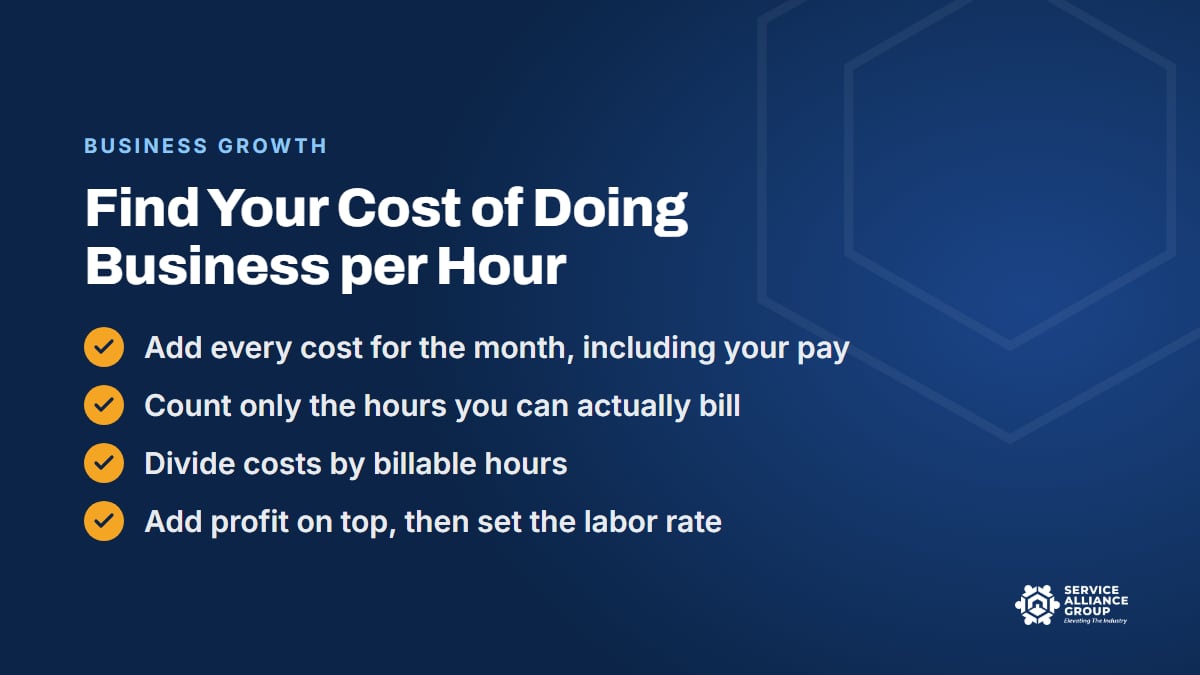
The second half is where the math usually goes wrong. A tech on the clock for 45 hours does not bill 45 hours. Drive time, parts runs, callbacks, and the twenty minutes waiting for a customer to find the breaker panel are all unbillable. Pull your real billable hours from your invoices instead of assuming a full week.
Example only: a one-truck shop with $11,000 in total monthly costs, including the owner's pay, that bills 100 hours in the month (about 23 a week) has a cost of doing business of $110 per billable hour. Charge $95 an hour and the shop comes up $15 short on every billable hour, about $1,500 for the month. Charge $110 and it breaks even.
Profit only starts above that line, so add the profit you want on top. At 20 to 25 percent, this example rate becomes $132 to $137.50 an hour.
Our free Cost of Doing Business calculator does this math in a few minutes. Run it once now, and run it again every time a big cost changes: a new truck, a new hire, an insurance renewal. When you hire, remember that the true cost of a technician's hour includes payroll taxes, workers' compensation, and benefits, not just the wage. The SBA has a plain summary of employer costs and obligations worth reading before the first hire.
Rule 2: Set a Diagnostic Fee That Pays for the Visit
The diagnostic fee is often the most argued-about number in appliance repair pricing, and the argument usually happens on the phone with a customer who found a shop that "comes out free." Here is what the fee actually pays for: the drive there, the drive back, the time in the laundry room, the meters and manuals that made the diagnosis possible, and the years it took you to read a dryer by ear.
Price it from Rule 1. Example only: if a diagnostic visit takes 75 minutes of a tech's day once you count both drives, and your cost of doing business is $110 an hour, the visit costs you $137.50 before any profit. A $59 diagnostic fee on that visit comes up $78.50 short on every call that does not turn into a repair, and some never will, because the customer decides to replace the machine.
Then pick one fee policy and use it on every call. These are the three you will run into:
- The diagnostic fee stands alone. The repair is priced separately. Simple and honest, and the repair price can stay lower because it does not carry the diagnosis.
- The diagnostic fee applies toward the repair. The customer sees it as credit. This works as long as the repair price was built to include the diagnosis time, because otherwise you are working the first hour for free.
- No diagnostic fee at all. The shop that "comes out free" still pays for every drive and every diagnosis. The repairs have to carry that cost, and every visit that ends without a repair is a straight loss. If you run it, know exactly what those unpaid visits cost you every week.
Whatever the policy, the CSR explains it on every call before booking, in plain words, along with what the visit includes. A customer who hears the diagnostic fee, what it covers, and that the repair quote comes in writing rarely argues. A customer who finds out at the door usually does. The free Appliance Repair CSR Course covers presenting the fee, and our post on appliance repair CSR phone skills walks through the same call.
Rule 3: Pick Flat Rate or Time and Materials, Then Build the Book From Your Numbers
There are two honest ways to price the repair itself. Time and materials bills the hours the job took plus the parts. Flat rate bills a set price for a defined repair regardless of how long it took, built from the average time that repair takes your techs. Both can be profitable. Neither works when the rate underneath it was borrowed from somebody else.
Time and materials is simpler to set up and easier to explain, but it punishes your best tech. The faster they work, the less the job pays. Many customers also dislike not knowing the number until the work is over, and a clock that runs while your tech walks to the van can make the visit feel adversarial.
Flat rate rewards speed and skill, gives the customer a firm number before the work starts, and makes the CSR's job easier. The catch is that it only works if the book was built from your own job history and your own cost of doing business, and then job costed to see which repairs are losing money. A flat-rate book copied from another shop is somebody else's cost structure with your logo on it, and it is one of the most expensive appliance repair pricing mistakes a shop can make.
To build one, list your 30 or 40 most common repairs (the dryer heating element, the washer drain pump, the refrigerator defrost failure, the dishwasher inlet valve, and so on). Pull the average labor time for each from your invoices, multiply by your hourly rate from Rule 1 (cost of doing business plus profit), and add the part at its marked-up price. Round up, not down.
Then give the tech three options to present where they fit: the repair, the repair plus a maintenance item, and the honest replacement conversation. Our post on the appliance repair service call covers presenting options instead of one number.
Rule 4: Mark Up Parts in Tiers and Price the Second Visit
Parts markup covers more than the part. It pays for the time to look it up and confirm the number, the order, the tracking, the return trip when it arrives, the restocking fee when it was wrong, and the warranty visit when it fails. A flat percentage across every part ignores all of that. A $9 thermal fuse and a $400 control board take about the same time to look up, order, and handle, so they should not carry the same markup percentage.
A tiered schedule solves it. Example numbers only:
| Your cost for the part | Example markup |
|---|---|
| Under $25 | 150 to 200 percent |
| $25 to $100 | 100 percent |
| $100 to $250 | 60 to 75 percent |
| Over $250 | 35 to 50 percent |
At those example tiers, a $10 part sells for $25 to $30 and a $300 board sells for $405 to $450. Set a minimum parts charge as well, so a $2 part never shows up on an invoice for $5. Write the tiers into your software and the markup stops being a judgment call the tech makes in the driveway.
The second visit is where a lot of appliance repair pricing quietly falls apart. The tech diagnoses, orders the part, and comes back three days later to install it. That is two drives and two visits for one repair. Either the flat-rate price for repairs that usually need a parts order includes the return trip, or you charge for it explicitly, but one of those has to be true.
Collect a deposit that covers the part cost before you order, so a canceled job does not leave you holding a $300 board and a restocking fee.
The cheapest second visit is the one that never happens. Stocking the van from real job data and confirming the part number against the model's service manual before you order are two of the biggest levers. Our guide to improving your first-time complete rate covers both, and Appliance Atlas confirms the OEM part number, with price and stock, before the order goes in.
Rule 5: Know the Math on Home Warranty Work and Discounts
Home warranty companies set the rates they pay, often have their own rules for how parts are sourced and billed, and pay on their own schedule. None of that is bad by itself, but it means home warranty work needs its own appliance repair pricing math, with your cost of doing business in one column and their rate in the other.
Example only: if a warranty company pays $75 for a call that takes your tech two hours, counting the drive and the phone time to get authorization, that job brings in $37.50 an hour against a cost of doing business of $110. Fill a slow Tuesday with those calls and you may lose less than sitting idle. Build the business on them and you will be busy and broke.
Track warranty revenue per hour separately, watch how long they take to pay, and cap them at a share of the schedule you decide on purpose.
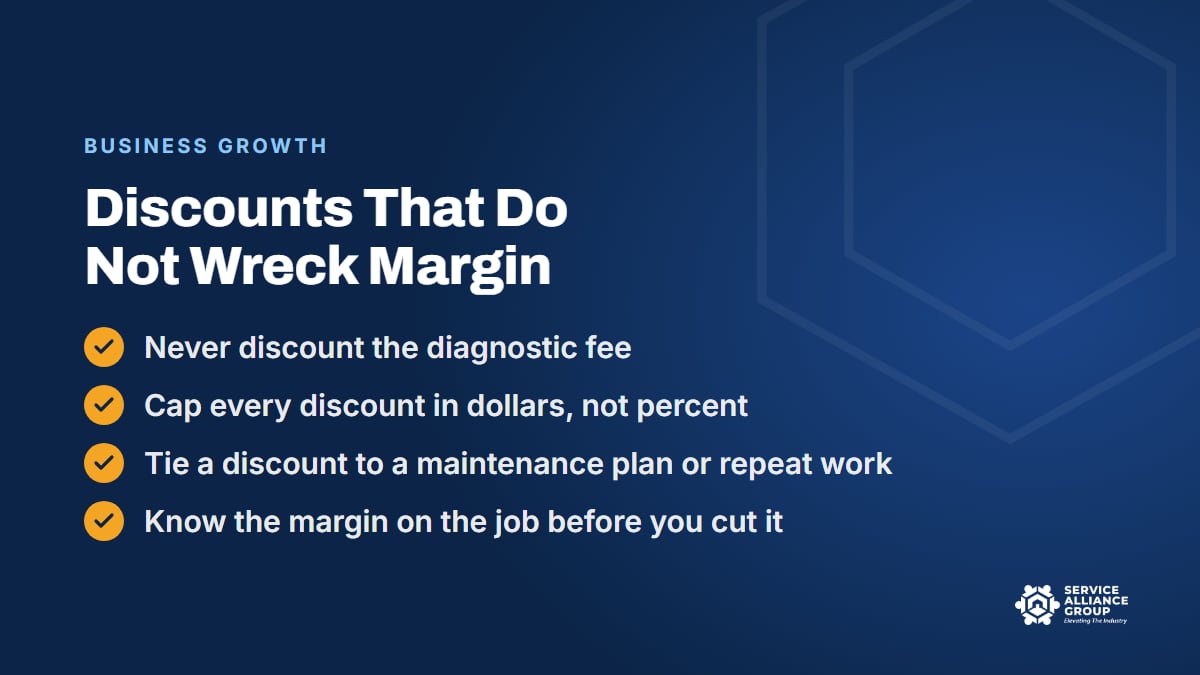
Discounts deserve the same math. Example only: on a $350 repair with a $120 part, your labor and parts markup might leave $90 of profit after the cost of doing business is covered. A 10 percent coupon takes $35 of that $90, more than a third of the profit, to save the customer the price of a pizza. The coupon is rarely why a customer chooses you. Answering the phone and having a slot tomorrow usually matter more.
If you want to discount, do it on purpose: a fixed dollar amount rather than a percentage, never on the diagnostic fee, and only where it earns something back, like a maintenance plan sign-up or a repeat customer. When a customer pushes on price, offer options instead of a lower number. Our post on how much a customer is worth shows why the relationship is worth more than any single ticket.
Rule 6: Job Cost Every Week and Review Prices Every Year
Appliance repair pricing is not something you set once. Parts, fuel, insurance, and wages move every year, and rarely down. If your prices have not moved with them, your margin has been shrinking quietly while your revenue looked fine.
Job costing is the habit that shows you where the money goes. Every week, for every closed job, put the revenue next to what it cost you: the part at your cost and the billable hours at your cost of doing business per hour. Sort by repair type. Within a month you will know which repairs make money, which ones break even, and which ones you should price higher or stop offering. Then roll it up into a weekly P&L so the shop's whole picture fits on one page.
Once a year, on a date you put on the calendar, rerun your cost of doing business, rebuild the flat-rate book from it, raise the diagnostic fee if the visit cost moved, and raise whatever else needs raising. Update the website, the phone script, and the price book the same day. Then watch your phone booking rate for a month. If it holds, keep the new price.
If you are still building the first version of these numbers, our guide to starting an appliance repair business covers the startup budget and the first pricing pass.

The Pricing Lessons Inside the S.O.S. Course
Two lessons in The S.O.S. Course go further on the appliance repair pricing math in this post: The Diagnostic Fee + Parts Markup Formula in the Start stage, and Job Costing and the Weekly P&L in the Operate stage. The first covers the formula behind your diagnostic fee and parts markup. The second makes job costing a weekly habit, so a losing repair type shows up in weeks instead of at tax time.
The S.O.S. Course (Start, Operate, Scale) is one course in three stages, worked in order: 70 lessons, more than 21 hours, and 70 downloadable tools, including 12 live spreadsheets that do the math for you. Each stage ends with a quiz, and the course ends with a master test and a certificate of completion. You can see the curriculum on the S.O.S. Course page and in the member portal.
Frequently Asked Questions
Should the diagnostic fee be applied toward the repair?
Either policy works if the repair prices were built to carry it. Applying the diagnostic fee as credit feels generous to the customer and is easy for the CSR to explain, but your flat-rate prices then need to include the diagnosis time, or you are working the first hour for free. Keeping the fee separate is simpler and keeps repair prices lower. Pick one, write it into the phone script, and never waive it to zero.
What is a fair parts markup for appliance repair?
There is no single fair percentage, because the right markup depends on the part cost and what it takes to handle it. Tiered markup solves that: a high percentage on inexpensive parts, a lower one on expensive parts, and a minimum parts charge so a small part never shows up on the invoice for a few dollars. Build your tiers from your own handling time, then check them with weekly job costing.
How often should I raise appliance repair prices?
Review every price once a year on a fixed date, and rerun your cost of doing business any time a big cost changes, like a new truck, a new hire, or an insurance renewal. Small yearly increases rarely draw attention. A big catch-up increase after five years of flat prices is what customers notice. Watch your booking rate for a month after each change, and if it holds, keep the new price.
Should I put my prices on my website?
Put the diagnostic fee on it, with a plain sentence about what it includes and whether it applies toward the repair. Customers who see the fee before they call are less likely to argue at the door, and the ones who want a free visit filter themselves out before they tie up your phone. Full repair prices are harder to publish, because the same symptom can be five different repairs, so give a range at most.
Is home warranty work worth taking?
It can be, as filler on slow days, as long as you calculate revenue per hour on those jobs against your cost of doing business and track how long they take to pay. It stops being worth it the moment warranty calls crowd out full-price customers or your receivables stretch. Cap it at a share of the schedule you choose on purpose.
Price from your costs, check the numbers every week, and the busy weeks will finally show up in the bank account, not just on the dispatch board.