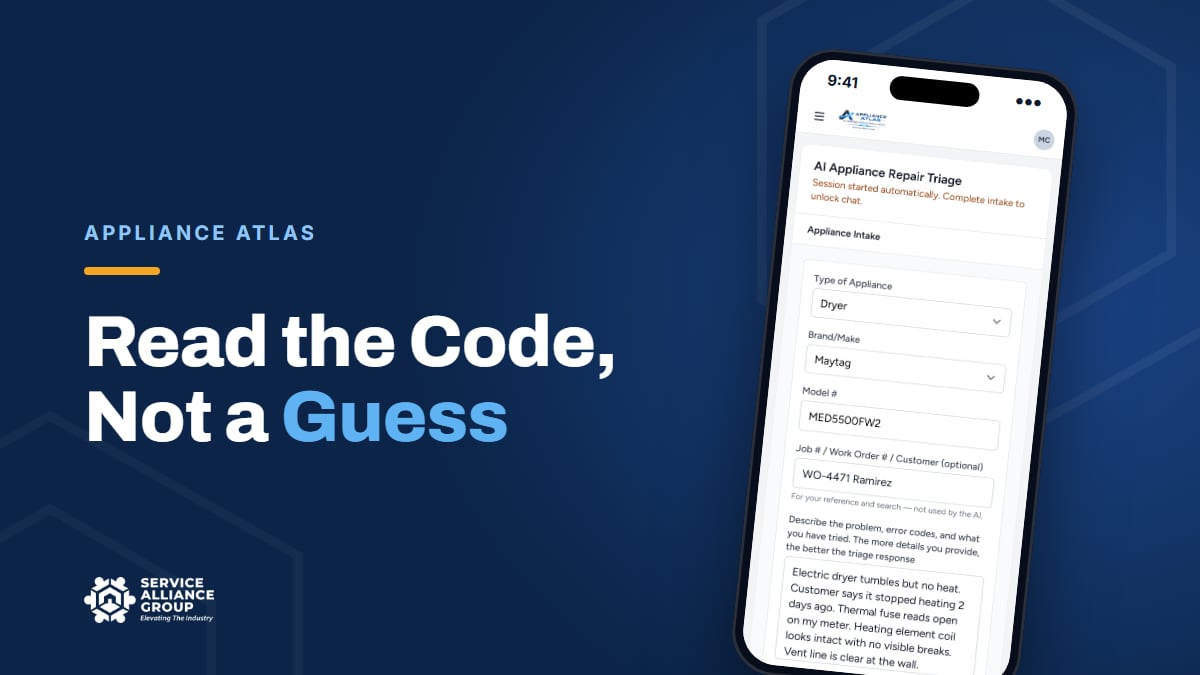
The Appliance Repair Service Call Playbook: 10 Steps to 5 Stars

Every appliance repair service call gets graded twice. The machine grades the repair. The customer grades everything around it: the text before you arrived, where you parked, what you did about your boots, and whether they understood what you found.
Customers cannot check your meter readings, but they can check all of that, and it is often what ends up in the review. This playbook walks a technician through ten steps, from the on-my-way text to the review ask, plus what to do when a customer calls back. None of it takes new tools, just the same small habits on every service call, including the one at 4:45 on a Friday. That is how a shop earns five stars week after week.
Table of Contents
Steps 1 to 3: The Text, the Curb, and the Knock
Step 1: Send the on-my-way message
An appliance repair service call starts before you pull up. A customer who has been watching the window since 8 a.m. wants to know who is coming and when. Send the on-my-way text before you pull away from the previous job, with your first name, a photo, the van to look for, and an honest arrival time.
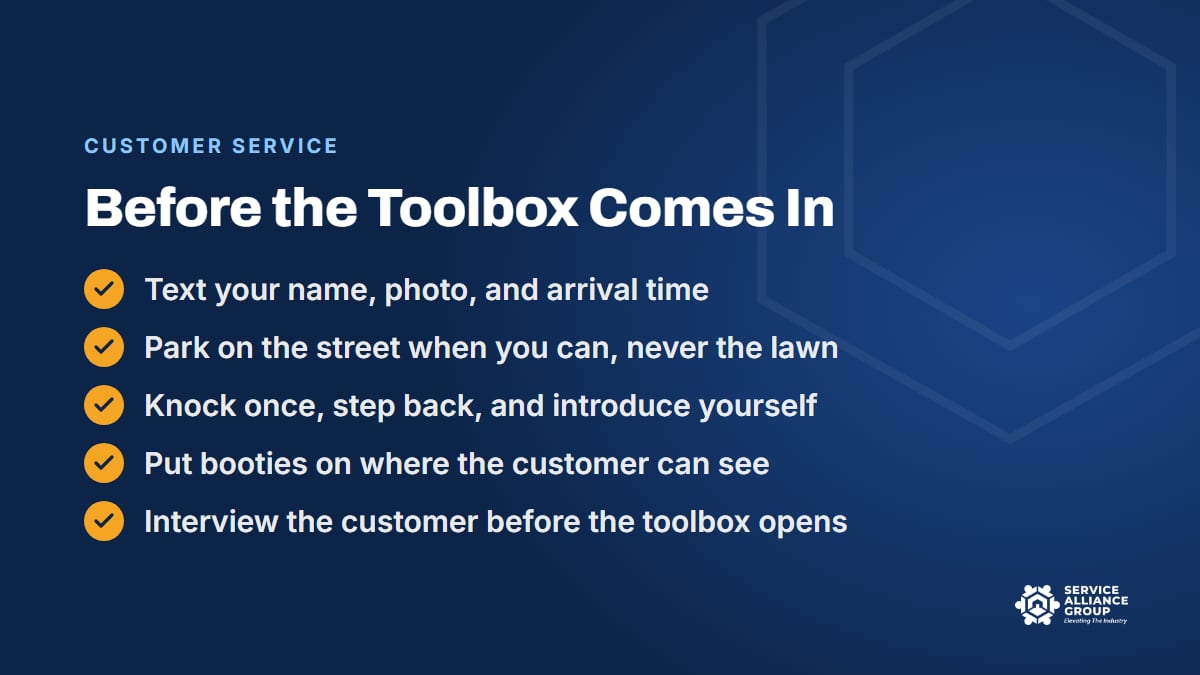
Something like: "Hi, this is Marcus from [Company]. I'm headed your way and should be there around 10:40 to look at your dryer. Look for the white van with our logo." If you are going to miss the window, the customer should hear it from you or the office before it closes, not after they call to ask.
Before you roll, reread the job notes: the appliance, the model number, the symptom, what the office said about the diagnostic fee, and anything about pets or parking. That intake only helps if you read it. Our pre-service checklist covers the rest of what to check, and our guide to appliance repair CSR phone skills shows what the office should be collecting.
Step 2: Park right and use the right door
Park on the street when you can, and never on the lawn. A van in the driveway can trap a customer who needs to leave, and an oil spot on fresh concrete is a complaint waiting to happen. If the street is not an option, ask before you pull in.
Use the door the customer asked for when they booked the service call, and the front door if nobody said. Before you get out, finish your phone call and take a look in the mirror, because the customer may already be watching from the window.
Step 3: Knock, step back, and introduce yourself
Knock or ring once, then step back so you are not filling the doorway when it opens. Keep your company shirt or ID badge visible. When the door opens, give your name, your company, and the reason you are there: "Hi, I'm Marcus with [Company]. I'm here to take a look at your dryer."
Then wait to be invited in. It takes two seconds and tells the customer you know you are a guest in their home. If a dog is barking behind the door, ask them to put it away before you step inside, for the dog's sake and yours. Those first ten seconds at the door set the tone for the whole service call.
Steps 4 and 5: Protect the Home and Interview the Customer
Step 4: Put on booties and lay down a drop cloth
Put shoe covers on at the door, where the customer can see you do it. Then lay a drop cloth or mat in front of the appliance before the first tool comes in, and set your toolbox on it instead of the counter or the hardwood. Both habits cost almost nothing, and customers notice both.
Ask before you move anything, from the laundry basket to the rug in front of the dishwasher. If a washer or range has to come out of a tight spot, point out any scuffs already on the floor or the wall before you slide it, so nobody wonders later.
Step 5: Interview the customer before the toolbox opens
The customer knows things the machine cannot tell you, and two minutes of listening can save a lot more than that later in the service call. Before you open the toolbox, ask:
- What is it doing, or not doing?
- When did it start, and did anything happen right before, like a power outage, a move, or an overloaded wash?
- Have you seen an error code, heard a new noise, or smelled anything?
- Has anyone else worked on it?
- Is anything riding on it, like a houseful of guests this weekend?
If there is a code on the display, write it down exactly. Our post on appliance error codes explains why the code is where the diagnosis starts, not where it ends.
Then say it back: "So it runs but won't heat, it started Sunday, and nobody else has looked at it. Let me take a look." The customer knows you listened, and you start with the best information you will get all day.
Step 6: Work Where They Can See You and Explain in Plain Words
Nothing makes an appliance repair service call feel longer than a tech who disappears behind the washer for forty minutes in silence. If the customer wants to watch, let them, and give short updates at the natural stopping points: when you find the problem, when you confirm it, and before you order or install anything. If they would rather go about their day, tell them when you will come find them.
When you explain what you found, drop the jargon. "The high-limit thermostat is open" means nothing to most homeowners. "The safety switch that shuts off the heat when the dryer gets too hot has failed, so it runs but won't heat" makes sense to anybody. Show them the part, or a photo of it, whenever you can.
Two rules keep this on the right side. Never talk down to a customer, and never trash the brand they bought or the last company that worked on the machine. Then test your explanation: could the customer repeat it to a neighbor tonight? If so, the options you present next will make sense to them too.
Steps 7 and 8: Options, Price Pushback, and Repair or Replace
Step 7: Present options instead of one number
One price at the end of an appliance repair service call is a yes-or-no question, and no is an easy answer for a nervous customer. Options turn it into a choice. Where it fits, offer two or three: the repair itself, the repair plus worn parts you found and can show the customer, and, when it is the honest answer, replacing the machine.
Put each repair option in writing, on paper or a tablet screen, priced from your price book with what it includes (parts, labor, and your repair warranty if you offer one). The customer should be comparing options, not trying to remember what you said.
Explain each option in plain words and let the customer choose. Do not decide what they can afford based on the house or the car in the driveway. Some customers want the cheapest fix that gets them to the weekend, others never want to think about that machine again, and both are good customers.
Step 8: Handle pushback and repair or replace honestly
Price pushback is normal, so do not take it personally. Acknowledge it ("I understand, that's more than you were hoping for"), walk back through what the price includes, and point to the other options. Do not cut the price on the spot to save the sale, because a number that drops the moment someone frowns tells the customer the first number was padded. If your shop gives discounts at all, set the rules ahead of time and put them in writing.
A lot of pushback sounds like "For that money, I might as well buy a new one." Sometimes they are right. Talk through what actually matters: the age of the machine, the repair price against the cost of replacing it, the condition of everything else inside it, and how long they plan to keep it. If they ask what you would do in their shoes, tell them.
Never push a repair on a machine that is not worth fixing, and never push replacement to get out of a hard job. A tech who says "Honestly, I wouldn't put money into this one" gives up a ticket and can earn a customer who calls about every other appliance in the house. If the customer says no to everything, stay friendly, collect the diagnostic fee under your policy, and leave the written options behind.
Steps 9 and 10: Finish the Service Call Clean and Ask for the Review
Step 9: Leave it clean and teach one thing
Cleanup is part of the appliance repair service call. Pick up every screw and wire tie, take the old parts with you unless the customer wants them, wipe your fingerprints off the appliance, and put back everything you moved. Then run the machine with the customer watching, so the last thing they see is their machine working.
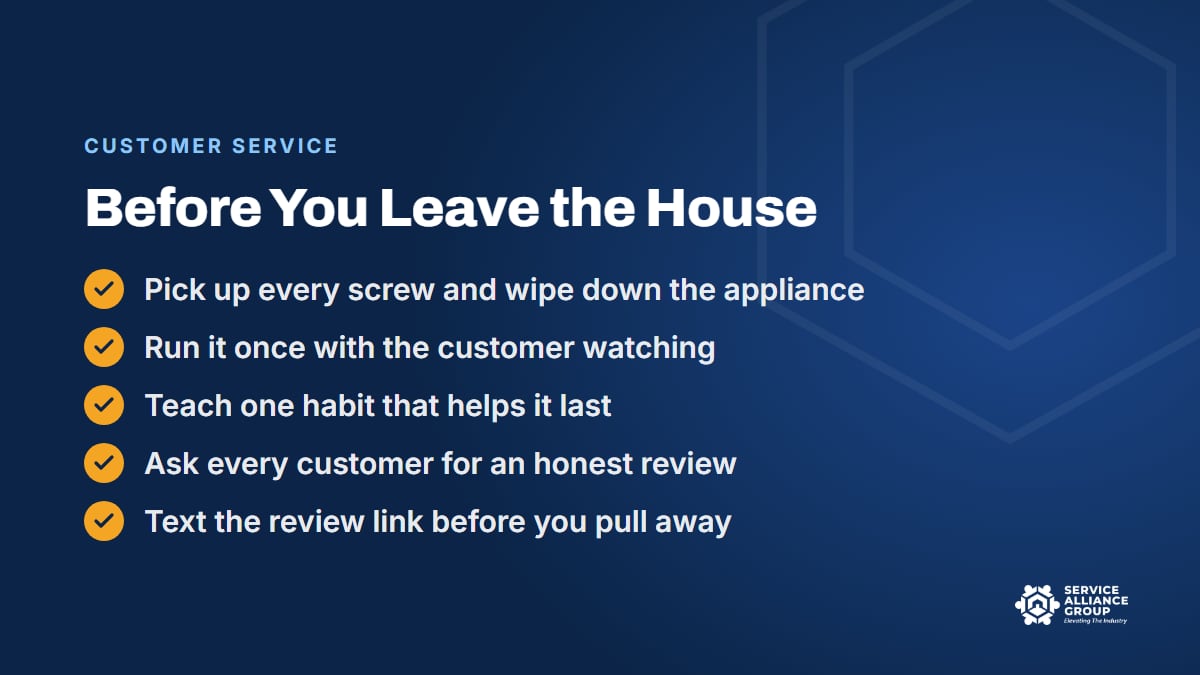
Before you leave, teach one thing that helps the appliance last, and keep it to one: clean the dryer lint screen every load, leave the front-load washer door open between washes, or clean the dishwasher filter. It shows you care what happens after you drive away.
That is also the natural moment for the maintenance plan conversation, if your shop offers one. Explain it the way you would to a neighbor (what gets checked, how often, and what members get), leave the handout, and stop there. A plan offered as a favor gets considered, and one pushed like a closing script gets resented.
Step 10: Ask every customer for the review
At the end of the visit, make the ask in plain words: "Would you mind sharing how today went on Google? I'll text you the link so you can do it whenever it's convenient." Send the link before you pull away. Save the referral ask for a follow-up message a few days later, as our guide to customer referrals explains.
Use the same words with every customer, whether the machine is running again, a part is on order, or they decided not to repair it. Do not save the ask for the service calls you expect to earn five stars. Google's policy on fake engagement says businesses should not selectively ask for positive reviews, offer incentives such as discounts in exchange for any review, or pressure customers into leaving one.
The same policy says not to request specific content in a review, including content that identifies a staff member. So never script the review, and never ask a customer to mention a tech by name.
When It Breaks Again: Handling the Callback
A callback is the service call nobody wants. The customer paid, the machine failed again, and the review is already half written in their head. How the next ten minutes go matters more than whose fault it was.
Whoever takes that call starts by listening. Let the customer tell the whole story without interrupting, apologize for the trouble, and save the explanations until someone has actually looked at the machine. Then get back out fast, ahead of routine work if you can, because a callback that sits for three days turns into a second complaint.
Before the return trip, the tech should reach out personally: "I heard the dryer is acting up again. I'm sorry about that, and I'll be there at 9 tomorrow to take a look myself." That one message tells the customer the person who did the work is taking ownership.
On site, run the same playbook as the first service call: booties, a short interview, and a plain explanation of what failed. If the miss was yours, own it and do not bill for the trip. If it is a new failure, show them, explain it, and let them decide. A callback handled that way can still end in five stars.
Back at the shop, log every callback by tech and by appliance type, and talk about the pattern without blame. Our guide to improving first-time complete rates covers bringing that number down.
Make the Playbook a Habit on Every Appliance Repair Service Call
A playbook only works if it survives a busy week. These habits keep it alive:
- One step per morning meeting. Pick a step, talk about it for five minutes, and ask who handled it well yesterday.
- Ride-alongs that score the whole service call. When you or a lead tech rides along, score the ten steps, not just the repair.
- Reviews read out loud. Read new reviews to the team, the critical ones along with the five-star ones. When customers mention the booties, the explanation, or the cleanup, those words show you which steps they notice.
- A written procedure. Put the playbook in writing so every new tech learns it the same way. Our guide to writing appliance repair SOPs shows how, and the SOP Library has customer service documents to start from.

Free Training for Your Techs: 5 Star Service Calls
We built 5 Star Service Calls to teach the customer side of every appliance repair service call, and it is free in our member portal. It is 38 short lessons on soft skills for technicians, with a final test at the end.
The lessons cover the on-my-way message, parking and the door, the knock, floor protection, the customer interview, working where the customer can see you, explaining in plain words, options instead of one price, handling pushback, repair or replace, maintenance plans, leaving it clean, and asking for the review. They also cover two of the hardest moments on the job: the angry customer and the callback.
Assign it to every new tech in their first week, and use it as a refresher for your experienced techs. For the phone side of the appliance repair service call, the free Appliance Repair CSR Course trains the person who books it. And to compare notes with other owners, join The Alliance, our free private Facebook group of more than 5,500 appliance repair business owners.
Frequently Asked Questions
Should techs wear shoe covers on every service call?
Yes, unless the customer asks them not to or the floor makes it unsafe. Shoe covers can be slippery on stairs and smooth floors, so keep a non-slip pair in the van for those homes. Put them on at the door where the customer can see, and take them off on the way out. It is one of the cheapest ways to show respect for someone's home.
Can my techs ask customers for five stars?
Ask for an honest review, not for five stars. Asking only happy customers, offering a discount in exchange for a review, or telling people what to write (including asking them to name the tech) all run against Google's review policy. The Federal Trade Commission's 2024 rule on fake reviews also bans incentives conditioned on a review being positive or negative. Do the ten steps well, ask everyone, and let the visit earn the rating.
Should a tech bring up the maintenance plan on every appliance repair service call?
Bring it up when it fits, not as a script on every visit. The natural moment is right after teaching the one thing that helps the appliance last, or when a customer asks how to avoid another breakdown. Explain it once in plain words, leave the handout, and let the office follow up. A customer who feels cornered at the end of a good visit remembers the corner, not the repair.
What should a tech say when the part has to be ordered?
Set the expectation before you leave the house. Tell the customer which part is coming, roughly when it should arrive, who will call to schedule the return visit, and whether the appliance is safe to use in the meantime. Then make sure the office follows through with a text when the part ships. A customer living without a dishwasher for a week can handle the wait, but the silence is what gets a bad review.
The repair gets the machine running. The ten steps around it are what the customer tells the neighbors about, and they are how an ordinary appliance repair service call turns into five stars.