
How to Scale an Appliance Repair Business: 7 Proven Stages

If you want to scale an appliance repair business, you probably know this wall. You are booked five days out, you are running eight calls a day, the phone rings while you are under a dishwasher, and the obvious answer is a second truck. Sometimes it is. But when the second truck arrives before the business is ready for it, the owner ends up with two trucks' worth of costs, one and a half trucks' worth of revenue, and less sleep than before.
Growth in this trade happens in stages, and the stages have an order. Skip one and the next one gets expensive. Here are the seven, from the owner-operator who knows every customer by name to a company that runs without the owner in the truck.
Table of Contents
Stage 1: Know Your Numbers Before You Scale an Appliance Repair Business
You cannot scale an appliance repair business on the bank balance and a gut feeling. Before a second truck, a second tech, or a second anything, the business needs three things you can produce in an hour: a KPI sheet, a weekly P&L, and a 13-week cash forecast.
The KPI sheet is one page, updated every week: calls received, calls booked (your booking rate), jobs completed per truck per day, average ticket, first-time complete rate, callbacks, parts margin, and revenue per truck. Those eight numbers tell you whether you have a demand problem, a conversion problem, a pricing problem, or a capacity problem, and each one has a different fix. Only the last one is fixed by a second truck.
The weekly P&L puts revenue next to parts cost, labor, and overhead for the week, so you know the margin you actually keep. The 13-week cash forecast lists every dollar coming in and going out for the next quarter, week by week. It is the tool that shows you the payroll crunch in week nine while there is still time to do something about it.
If our post on appliance repair pricing read like a to-do list, do that first. Growth multiplies whatever pricing you already have, including the mistakes.
Stage 2: Run the Second Truck Math Before You Buy It
A second truck means a lot more than a van. It means a technician, a second set of van stock, a second software seat, a second phone, insurance, fuel, maintenance, tires, lettering, tools, and a share of the office time it takes to keep two people busy. Add all of that up before you decide anything, because the van payment is often smaller than the wage line.
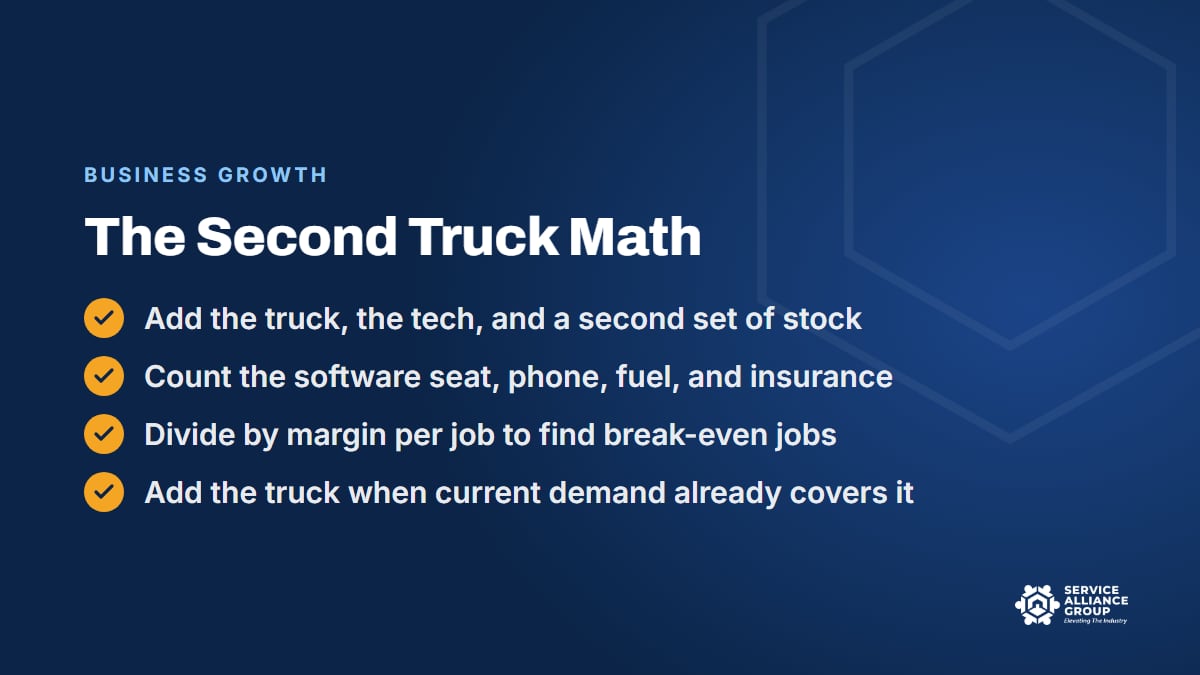
Example only. Say the fully loaded monthly cost of a second truck and the tech in it comes to $9,500: wages with payroll taxes and workers' comp, the van payment, insurance, fuel, maintenance, software, phone, and a share of office time. If your average completed job brings in $300 and the parts on it cost you $75, each job leaves $225 toward those costs.
That second truck needs about 43 completed jobs every month, roughly two a working day, just to break even. Your KPI sheet tells you whether the calls you are turning away or pushing out a week add up to that.
Lease or buy is a cash and tax question more than a truck question. Leasing usually keeps the upfront cost low and puts a newer van on the road, but many leases come with mileage limits and wear charges that add up when a tech drives a lot of miles. Buying, especially buying used, means you own the van with no mileage limit, but the repair bills are yours.
Run both through the 13-week forecast and ask your CPA how each one is treated on your taxes, because that answer changes by structure and by year.
One rule holds either way: buy the second truck for the demand you already have, not the growth you hope the truck will create. If the schedule is not full five days out with the calls you are already getting, the truck will sit, and a parked truck costs almost as much as a moving one.
Stage 3: Hire on a Trigger, Not on a Feeling
Hiring on a feeling looks like this: you are exhausted, a decent tech is available, and you hire them because next month looks busy. Hiring on a trigger looks like this: the booking rate is steady, the schedule has been full five or more days out for six straight weeks, you are turning away or delaying a set number of calls a week, and the second truck math from Stage 2 closes.
Write your trigger down before you need it, so a tired week does not make a growth decision for you.
The first hire is not always a technician. If you are running eight calls a day and the phone goes to voicemail while you work, the first hire that pays for itself may be the person who answers it. A CSR who books more of the calls you already get costs less than a truck and fills the schedule the second truck will need.
Our guide to hiring an appliance repair technician covers when the numbers say it is time, the job listing, the ride-along interview, and comp models, so we will not repeat it here.
Two things to decide before the offer goes out. First, the comp model: hourly, hourly plus a performance bonus, or a percentage of revenue, each with a different effect on speed, quality, and callbacks. Second, the onboarding plan: a structured ride-along with a checklist, not "follow me around for a couple of weeks." A tech who learns your way of running a call in the first 30 days is one you can trust with the second truck. Our post on training new appliance technicians lays out the ride-along plan.
The moment you have an employee, you take on obligations a solo operator does not have: payroll taxes, wage and hour rules, workers' compensation under your state's rules, and anti-discrimination laws that apply at employee counts set by federal and state law. Whether a tech is an employee or an independent contractor is a legal question too, and getting it wrong can be expensive.
The SBA's guide to hiring and managing employees and the EEOC's small business page are good starting points, along with your CPA, an employment attorney, and your state's labor department.
Stage 4: Build Dispatch Capacity and Route Density
Once you scale an appliance repair business past one truck, dispatch decides whether two trucks really do twice the work of one. Route density is how tightly you group calls, and it shows up in completed jobs per truck per day. A truck that runs six calls inside one zone finishes early. A truck that crosses the county twice finishes four calls, late and tired.
Zone your service area and assign zones to days, so north-side calls get booked on the north-side day, even if that means the customer waits a day. Set appointment windows the dispatcher can actually keep. Schedule parts-return visits into the zone they belong to instead of wherever there is a hole. Leave one same-day slot open per truck for the refrigerator that quits overnight. Our guides to route optimization and dispatching strategies go deeper on both.
Capacity is the other half. Know how many calls each tech can complete per day by job mix, and book against that number instead of against hope. When the board is full for every truck five days out, you are back at Stage 2 with better data. When one truck is full and the other is not, look at demand, dispatch, and the phone before capacity, because a third truck will not fix it.
At some point as you add trucks, dispatch stops being something the owner can do between calls. A dispatcher who owns the board, the parts follow-ups, and the on-my-way texts is often the hire that makes the next truck possible. Field service software helps here, but the software does not decide the zones. You do.
Stage 5: Get the Owner Out of the Truck
The owner in the truck is the ceiling. Every hour you spend on a service call is an hour nobody is hiring, pricing, coaching, selling, or looking at the numbers, and the company can only grow as fast as your spare time. Getting out of the truck is how the growth happens, so do not wait for growth to earn it.
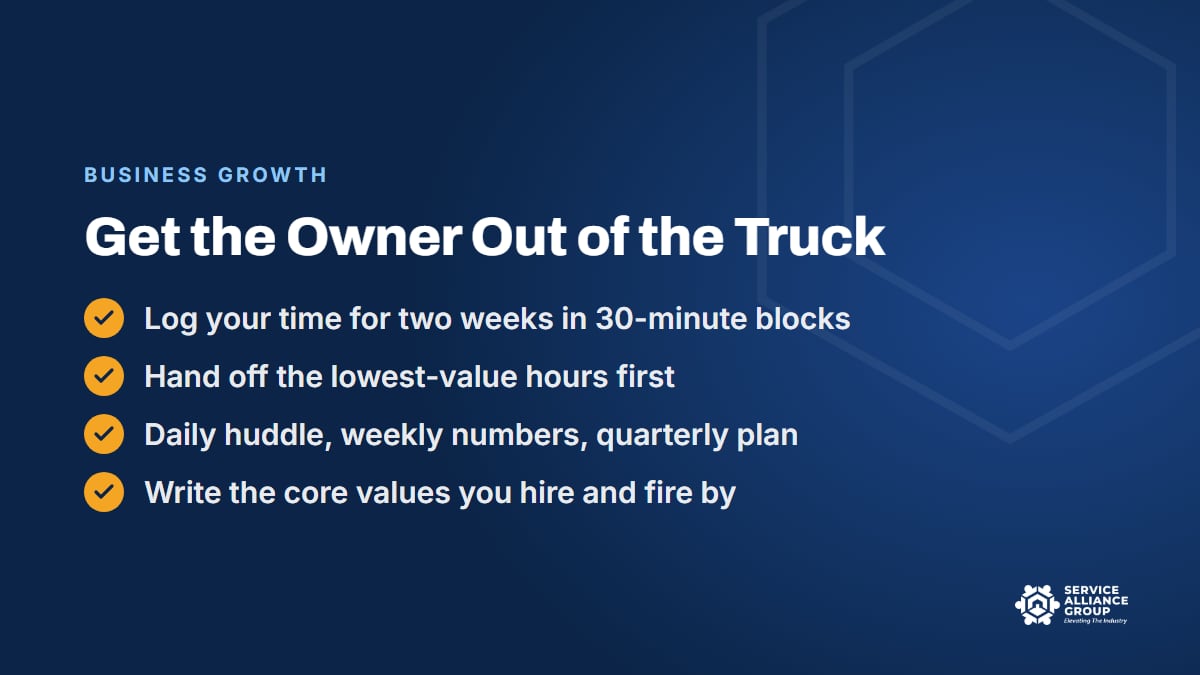
Start with an owner time audit. For two weeks, log every 30-minute block of your day in a note on your phone: service calls, driving, dispatch, phones, parts ordering, quoting, bookkeeping, hiring, training, and the block labeled "putting out a fire."
Then sort the list by what each hour is worth to the business. A service call is worth your billable rate. Dispatch is worth a dispatcher's wage. Building the hiring system is worth more than either, and it is the one that keeps getting pushed to next week. Hand off the lowest-value hours first.
Then give the company a rhythm that runs without you in the middle of every conversation. A ten-minute daily huddle: yesterday's numbers, today's board, stuck jobs and parts. A weekly numbers meeting: the KPI sheet, the weekly P&L, the cash forecast, and one problem to fix. A quarterly planning session: the hiring trigger, the pricing review, marketing, and the next stage. Same time, every time, whether or not it feels necessary. The meetings are where the team learns to run the shop while you are not there.
Culture is what happens on the call when you are not on it. Write down three to five core values in plain words a technician would say out loud, like "leave it cleaner than we found it" or "the customer hears the truth, even when it costs us the job," and use them in hiring, in ride-along reviews, and in the hard conversation when someone breaks one.
Written procedures hold the culture in place. Our guide to the benefits of standard operating procedures explains why, and the SOP Library has 159 editable documents in 13 categories to start from.
Stage 6: Add a Management Layer and Commercial Accounts
There is a point where the owner cannot ride along with every new tech, review every callback, and answer every "what do I do with this one" text personally, and the shop starts to fray. That is when growth needs a management layer: a lead tech or service manager who owns quality and training in the field, and an office manager who owns the phones, dispatch, and collections. Neither has to be a new hire. The best lead tech is often already on your payroll.
Pay the management layer for the results they own, not just for seniority. A lead tech paid partly on the crew's first-time complete rate and callback rate manages differently than one paid for years served. Give them a written scope, real authority to make small calls without you, and the weekly meeting as the place where the numbers get reviewed together.
With a management layer in place, commercial and property manager work becomes worth chasing. Apartment communities, property management companies, small landlords with dozens of units, and businesses with laundry equipment can give you recurring volume, predictable zones, and a customer who calls you first instead of searching.
They also tend to bring net terms, certificates of insurance, W-9 requests, and slower pay, which is why the 13-week cash forecast from Stage 1 matters more, not less, as those accounts grow. Price them from your cost of doing business with the payment delay built in, not from the discount they ask for.
Stage 7: Know What the Business Is Worth
Whether or not you ever plan to sell, run the company as if a buyer were looking at it, because the things a buyer pays for are the same things that make it run without you. Clean books that match the tax returns. Revenue that does not depend on the owner's phone number and the owner's hands. A team that stays. Recurring revenue from maintenance plans and commercial accounts. Written systems. Reviews, a brand, an owned phone number and domain, and a fleet with records.
Owner dependence is one of the biggest drags on value in this trade. A shop where the owner runs the best calls, knows every customer, and holds every process in their head is usually worth less to a buyer than one that would run the same if the owner took 30 days off, even at the same revenue. Every stage above moves the business toward the second kind.
When you want a number, get a professional valuation and talk with a qualified business broker, a CPA, and an attorney before anyone signs anything. Our posts on building a business worth buying and whether to sell walk through the drivers and the exit options: a sale, a family transition, or a management buyout.
Operate and Scale With the S.O.S. Course
The seven stages above line up with the Operate and Scale stages of The S.O.S. Course (Start, Operate, Scale), for owners who want to scale an appliance repair business without losing margin on the way.
Operate covers the numbers that run a shop: KPIs, job costing and the weekly P&L, the 13-week cash forecast, call conversion, first-time fix rate, van stock, dispatch and route density, reviews and follow-up. Scale covers when to hire, the first hire, comp models, onboarding and ride-alongs, fleet costs, the management layer, commercial work, and valuation and exit options.
It is one course in three stages, worked in order: 70 lessons, more than 21 hours, and 70 downloadable tools, including 12 live spreadsheets that do the math for you, with a quiz at the end of each stage, a master test, and a certificate of completion. Because the stages are worked in order, an owner who is already past startup still begins with Start, which covers the pricing math everything else depends on. You can see the course in the member portal.
The Alliance, our free private Facebook group, has more than 5,500 appliance repair business owners in it, and it is a good place to ask how other owners handled their second truck.
Frequently Asked Questions
When should I buy a second truck?
When the demand you already have covers the full cost of the truck and the tech in it, not before. The signs are a schedule full five or more days out for weeks in a row, calls you are turning away or pushing out, and a second truck break-even that your KPI sheet says you can hit from current call volume. If any of those is missing, fix the phone, the pricing, or the marketing first.
Should I lease or buy the second truck?
It depends on cash, mileage, and taxes. Leasing usually keeps the upfront cost low and the van newer, but mileage limits and wear charges can bite when a tech drives a lot of miles. Buying, especially used, means you own the van with no mileage limit, and the repair bills are yours. Run both through your 13-week cash forecast and ask your CPA how each is treated on your return.
How many technicians before I need a service manager?
There is no fixed number. The trigger is when you can no longer ride along with new techs, review callbacks, and answer every stuck-job question yourself without quality slipping. Watch the first-time complete rate and the callback rate. When they slide because you are stretched thin, the management layer is overdue. Look at your best tech before you hire from outside, and pay the role for the results it owns.
How do I scale an appliance repair business if I do not want ten trucks?
Growth does not have to mean a fleet. Two or three well-run trucks with a tight zone, a full schedule, a real dispatcher, and an owner who is out of the truck can be more profitable and far less stressful than eight trucks and chaos. Pick the size that fits the life you want, then build the systems that let the business run at that size without you carrying it every day.
Scale an appliance repair business in order. Know the numbers, do the second truck math, hire on a trigger, tighten dispatch, get out of the truck, build the layer, and keep the company worth something whether or not you ever sell it.