How to Train New Appliance Technicians Faster: 7 Proven Methods
The fastest way to train new appliance technicians is to treat ramp-up time as a cost, because it is one. From the first shift, you are paying a wage, slowing down whoever does the training, and waiting on new revenue that does not show up until the new hire can run calls alone.
A lot of that time goes to waiting instead of learning: riding along on whatever happens to be on the board, sitting through the same kind of call for the third time, or standing in a laundry room on the phone with the senior tech. Take out the waiting and the ramp-up gets shorter without cutting a single corner.
Here are seven methods that do exactly that. If you have not made the hire yet, start with our guide on how to hire an appliance repair technician, which includes a four-week ride-along plan. This post picks up from there, with the technician training that turns a new hire into someone you can dispatch alone.
Table of Contents
Why It Pays to Train New Appliance Technicians Faster
Ramp-up has two price tags. The first shows up during pairing, when two people ride in one van and bill like one. The second shows up when pairing ends too early and new technicians who are not ready start producing second trips, wrong parts, and callbacks under your company's name.
There is a quieter cost on the senior tech's side. Every stuck call from a new tech is a call your best tech answers from a customer's kitchen, which stops two jobs at once. A few of those a day and the new hire is slowing down your most productive van as well as their own.
Shops that train new appliance technicians faster still cover every step. They decide in advance what new technicians need to see and prove, then run that plan on purpose instead of letting the dispatch board decide it for them.
1. Build the Plan Around Job Categories, Not the Calendar
The first month can run on a calendar, like the ride-along plan in our hiring guide. After that, a calendar only tells you how long a new hire has been riding along, when what you need to know is what they can do. A plan built on job categories answers that, and it lets a new tech start producing in one category while still learning the next. That is how you train new appliance technicians faster without guessing at readiness.
Split your work into categories: laundry, dishwashers, cooking, refrigeration, sealed system, built-in and high-end brands, and home warranty calls, which come with their own paperwork. Order them by how often they show up on your board. If most of your calls are washers and dryers, laundry comes first, because that is where a new tech starts paying their way soonest.
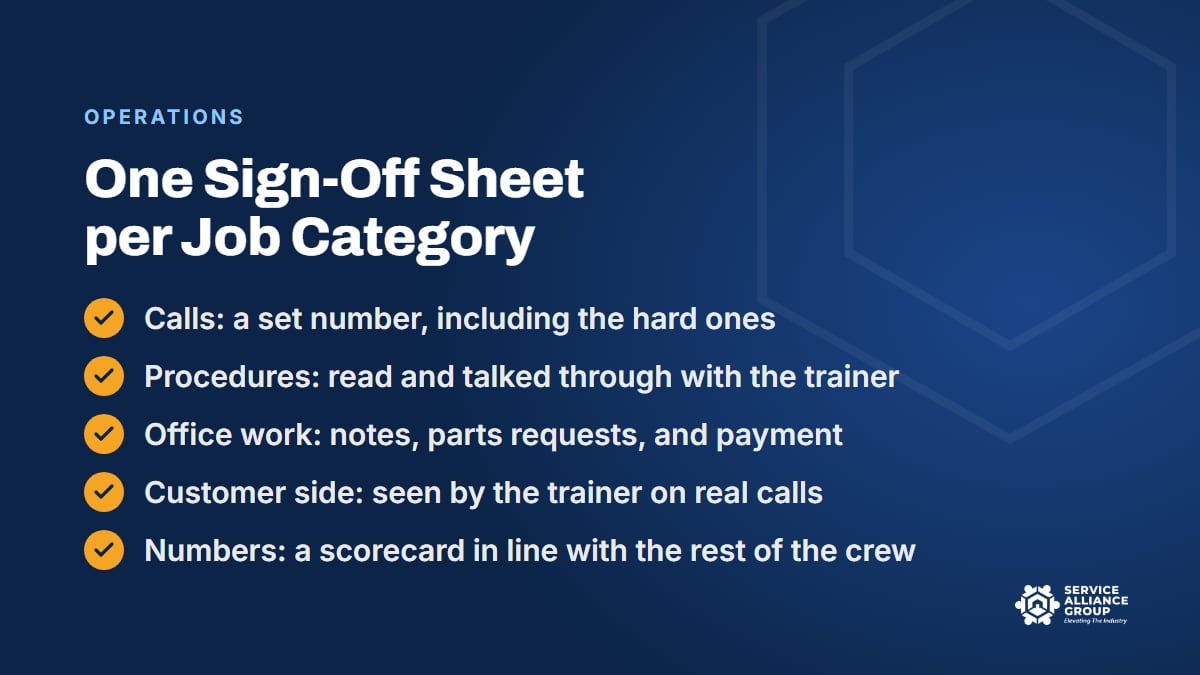
For each category, keep a one-page sign-off sheet that lists what new technicians have to show before that category goes on their solo list:
- Calls. A minimum number of real calls in the category, including the kinds that tend to trip new techs up.
- Procedures. The written procedures for that category, read and talked through with the trainer.
- Office work. Job notes the office can order from, parts requests, payment, and home warranty authorizations, handled without help.
- The customer side. The habits covered in method 5, seen by the trainer on real calls.
- Numbers. A scorecard for the category that looks like the rest of the crew's.
The trainer and the owner or service manager sign the finished sheet, and that signature should change something your dispatcher already uses. If you keep a skills grid, as our guide to effective dispatching strategies recommends, the signed sheet is what moves a new tech's name across it. Dispatch then sends solo calls only in cleared categories and keeps the rest paired.
The office work belongs on the sheet for a reason. A tech who can diagnose a dishwasher but cannot write a note the office can order from is not ready to run dishwashers alone.
2. Give Every Ride-Along Day a Goal
Ride-alongs are where most technician training happens, and where a lot of it gets wasted. A new tech who rides with whoever is free, on whatever is on that van's board, learns whatever that day happens to hold. Three changes turn the same hours into a plan.
Pick the trainer on purpose
Technician training rises or falls with the trainer, and your best technician is not automatically your best teacher. Look for the tech who explains without taking over, stays patient when a new hire is slow, and follows your procedures instead of their own shortcuts.
Then make training worth their while with a training rate, a bonus tied to the new tech's first solo month, or both. A trainer who feels the lost production and none of the reward will teach like it.
Load the training board deliberately
Work with dispatch the afternoon before. Give the pair calls in the category being trained, and make sure the new tech sees the calls that trip people up: a diagnosis-only visit where the customer declines, a return visit to install a part, a home warranty job, and a callback. New technicians who have only seen easy calls treat the first hard one like an emergency.
Give each day one goal the new tech hears about that morning: run every customer interview, write every job note, or talk through each test before running it. One clear goal beats a day of watching.
Debrief every day
End each day with ten minutes and three questions: what did you see today that you had not seen before, where did you guess, and what would you do differently tomorrow? Write the answers down, because they become tomorrow's goal and next week's plan.
3. Put Your Procedures in Writing Before They Start
When three people train a new hire three different ways, the new hire picks up a blend of all three. Written procedures are how you train new appliance technicians the same way every time, whoever is in the passenger seat that week. They also give new technicians something to reread at night instead of trying to remember what they were told on the third call of the morning.
Start with the procedures that do the most damage when new technicians get them wrong:
- The service call flow, from the on-my-way message to collecting payment.
- Job notes, including what a note must contain before the office can order a part.
- Parts requests and returns, so nobody orders from memory.
- Callbacks, including who goes back and how the cause gets recorded.
- Safety, covering gas, electrical hazards, and moving heavy appliances.
Keep each one short enough to read on a phone in a driveway, and tie it to a line on the sign-off sheet so reading it is part of clearing the category. Our guide to writing appliance repair SOPs covers the format, and the SOP Library has 159 editable documents in 13 categories, among them Safety and Compliance, Hiring and Recruiting, and Operations, if you would rather adapt than start from a blank page.
On safety, do not guess at your obligations as an employer. The OSHA website covers federal workplace safety rules, your state may add its own, and a qualified safety or HR professional can tell you what applies to your shop.
4. Use Manufacturer Training and Get Certifications on the Calendar
Manufacturers can carry part of the load when you train new appliance technicians. Many offer training for servicers on their product lines, some online and some hands-on, and brands you do warranty work for may have training expectations of their own. Ask each brand you service what it offers and what it requires, then fit those modules into the plan in the same order as your job categories.
New technicians who have worked through a manufacturer's module on the washer your shop sees every week show up to the ride-along already knowing the vocabulary. The trainer gets to spend the day on judgment instead of basics.
Sealed-system work has a legal gate. Under EPA Section 608, technicians who service or dispose of appliances that contain refrigerant need certification, and Type I covers small appliances such as household refrigerators and freezers. Until a new tech holds that certification, refrigerant work stays with a certified tech, so schedule the exam in the first weeks rather than the first year.
Budget technician training time honestly. A training day is a day the new tech is not producing, and it is tempting to push it back every time the board fills up. Put training dates on the schedule like any other job and let the board fill in around them.
5. Teach the Customer Side on Purpose
A new tech can get the diagnosis right and still lose the customer. The muddy footprint on a white kitchen floor, the explanation nobody understood, the single take-it-or-leave-it price, the forty minutes spent working with their back to the homeowner: those are the details customers remember and write reviews about.
Technician training that covers only the machine leaves out half the call. Give the customer side its own line on every sign-off sheet, with the same weight as the diagnosis: the on-my-way message, parking and the door, floor protection, the customer interview, explaining findings in plain words, offering options, and asking for the review.
Our free 5 Star Service Calls course was built for exactly this. It covers those habits plus handling pushback, repair-or-replace conversations, the angry customer, and callbacks, in 38 short lessons with a final test.
Assign it in the first week, and make finishing it a requirement for clearing the first category. Then use the daily debrief to compare the lessons with what happened on real calls. For the whole visit in one place, see our appliance repair service call playbook.
6. Measure Progress and Stop Pairing One Category at a Time
When you train new appliance technicians, the question that comes up every time is when to stop pairing. Gut feel is a poor answer, because it swings with whatever happened on the last call. Numbers hold steady, so from the first week, keep a short scorecard for each of your new technicians, split by job category:
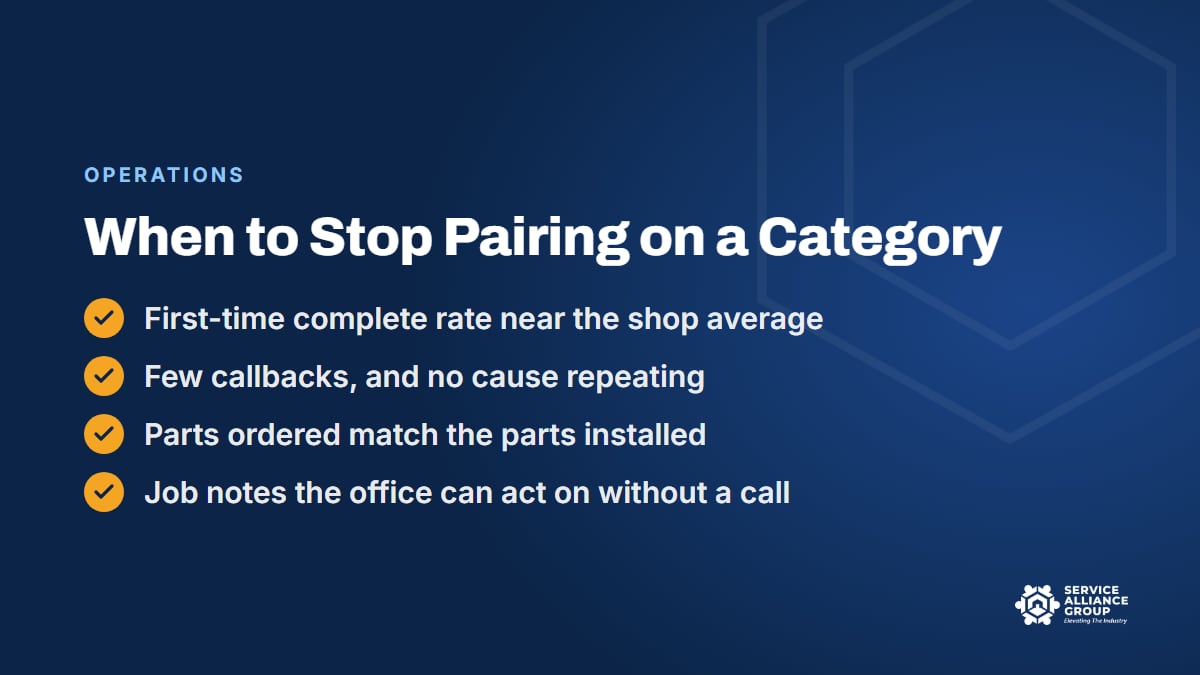
- First-time complete rate, compared with the shop average for that category. Our guide to raising your first-time complete rate shows how to count it.
- Callbacks, with the cause written down for each one.
- Parts ordered versus parts installed, which shows guessing and wrong parts early.
- Time on site, compared with the shop average for the same job type.
- Job notes the office can act on without calling the tech.
Stop pairing one category at a time. When a new tech's laundry numbers look like the rest of the crew's, laundry goes solo while refrigeration stays paired. If the numbers slip later, pair up again on that category and say plainly that it is information, not punishment.
Sit down for fifteen minutes each week during the first few months and go through the scorecard together. Showing new technicians the same numbers you look at keeps the conversation about the work.
If you are building a scorecard like this for the first time, the Operate stage of the S.O.S. Course covers the KPIs that run a shop, including first-time fix rate. The Scale stage covers first hires, comp models, onboarding, and ride-alongs.
7. Give New Technicians a Reference They Can Trust
The day pairing ends is the day the phone calls start. A new tech on a solo call sees a code they have never seen, or a symptom that could point at two different components, and the only reference they trust is the senior tech's number. Each call pulls your best tech away from their own customer, and new technicians who feel bad about calling will sometimes guess instead, which costs more.
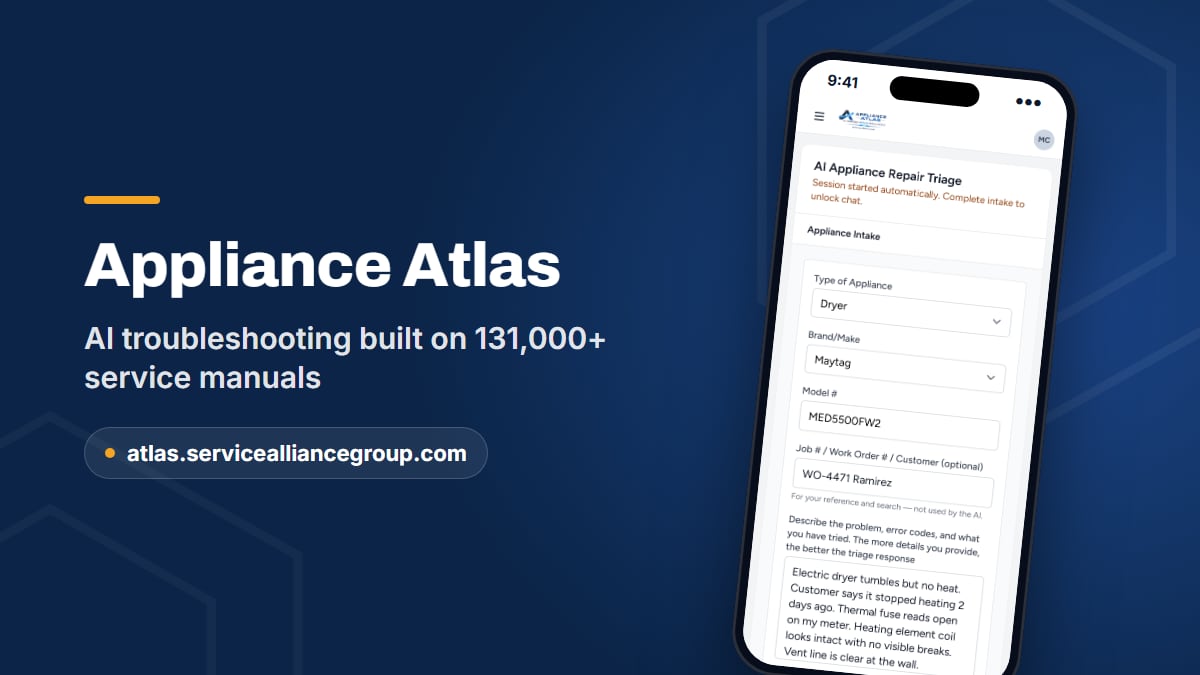
That gap is where Appliance Atlas fits. A new tech enters the brand, model, and symptom. Atlas pulls that model's service documentation from a library of 131,000+ service manuals and answers from it, covering error code meanings, test procedures, and component checks. The answer comes from the service documentation for that machine instead of a forum thread or a general chatbot's guess.
For shops that train new appliance technicians, four things matter most:
- Answers grounded in the manual for that model, so new technicians learn the right test procedure from the start instead of a shortcut that worked on a different machine.
- Part number confirmation before ordering. Atlas checks the OEM part number against a live wholesale catalog, with price and stock, so a new tech's first parts orders are checked before they go in.
- Saved, searchable history, so a new tech can pull up what they looked up that day and walk through it in the debrief.
- Seats for the whole crew, so your newest hire and your most experienced tech work from the same reference.
Techs can also request a missing model from inside the app and download manuals as PDFs, all from a phone in the field. Atlas is a standalone subscription with its own sign-up at atlas.servicealliancegroup.com, so you can put it on the crew without buying anything else from Service Alliance Group.
None of this replaces the ride-along or the trainer's judgment. What it can cut down is the phone call that interrupts your best tech after the ride-along ends.
Frequently Asked Questions
How long does it take to train new appliance technicians?
It depends on where they start and what your board looks like. An experienced tech from another shop mostly needs your procedures, paperwork, and customer standards, and can clear familiar categories quickly. Someone newer to the trade needs every line of the sign-off sheet in every category. Measure readiness by categories cleared and the numbers on the scorecard, not by weeks on the payroll.
Should I hire experienced technicians or train new technicians from scratch?
Both work, and both need a plan. Experienced hires ramp faster on diagnosis but bring habits from their last shop, so their technician training leans on your procedures and customer standards. Newer techs take longer on the technical side but have nothing to unlearn. Either way, the sign-off sheets, the scorecard, and the reference they carry stay the same.
What if my best tech does not want to train?
Take it seriously, because a reluctant trainer teaches badly. Ask what is in the way: lost production, lost pay, or simply not enjoying it. A training rate or a bonus tied to the new tech's first solo month can solve the first two. If it is the third, pick a different day-to-day trainer and use your best tech for short sessions on the hardest categories.
I am the only technician. How do I train someone?
You will be the trainer and the whole production of the shop at the same time, so lean on everything that does not need you in the room. Write the procedures down, assign the free 5 Star Service Calls course, schedule manufacturer training, and give the new tech a reference like Appliance Atlas. Block training days on the board like jobs, and compare notes with other owners in The Alliance, our free Facebook group.
No shop gets ramp-up perfect, and every hire teaches you something the last one did not. Write the plan, run it by category, measure it, and give new technicians a reference they trust, and you should be able to train new appliance technicians faster each time you hire.