
How to Hire an Appliance Repair Technician: 8 Essential Steps

Picture an owner who waits until they are buried in calls to hire an appliance repair technician, then rushes it. They are booked out a week, callbacks are creeping up, and the first person with a tool bag who answers the ad has a van on Monday. Six weeks later the owner is covering that tech's callbacks too, and the next hire feels even scarier.
The better way is eight hiring steps done in order, with your own numbers deciding the first one.
Table of Contents
Step 1: Know When to Hire an Appliance Repair Technician
Feeling busy is not a hiring trigger. A brutal August with three refrigerator calls a day is not one either, because September may look very different. What you want is a pattern that holds for a month or more, and you can see it in four places.
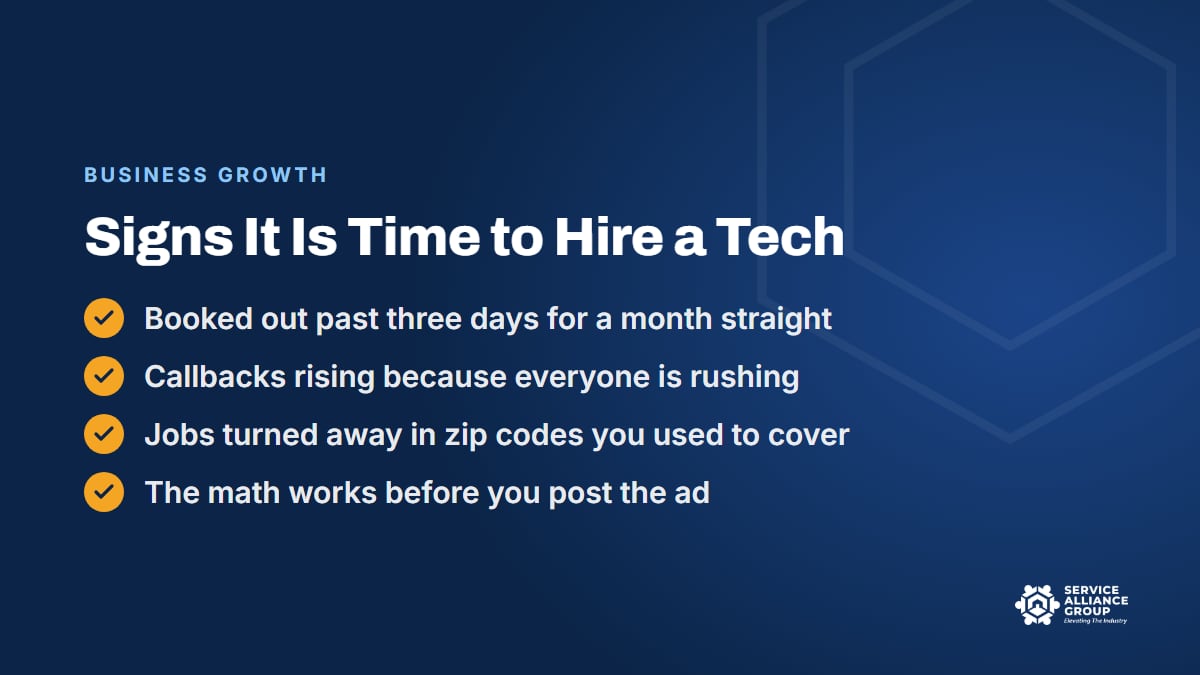
- Booking lead time. If a routine call, say a dryer that quit heating, sits three or more days out for four straight weeks, you are likely losing customers to whoever can come sooner.
- Turned-away work. Keep a tally for a month of every job you declined, pushed out, or quietly stopped taking in a zip code you used to cover. Those calls are the new tech's board.
- Quality slipping. Callbacks rising, tickets with thin notes, parts ordered without a proper test because everyone is racing to the next stop.
- The owner's day. If you run calls until six and do the books until eleven, the business has already outgrown one person.
Then do the math before you start hiring. A new appliance technician needs a full board, and a half-empty board is how a good hire turns into a payroll problem. Run your numbers through the Cost of Doing Business calculator, then run them again with the new tech's wages, payroll taxes, van, fuel, insurance, and tools added in. Leave room for the first few weeks, when a new hire is still learning and not producing much.
For example, say a solid tech averages $260 in revenue per call and runs five calls a day. That is $1,300 a day, or $6,500 across a five-day week, before parts. If the fully loaded cost of that seat comes out near $2,000 a week, there is room left for parts, overhead, and profit.
That only holds if you have five calls a day to hand over. At two calls a day, the same tech brings in $2,600 a week, and once parts and the $2,000 seat are paid, there is little or nothing left.
Step 2: Decide Who You Hire First: CSR, Tech, or Admin
When you are stretched thin, the obvious move is to hire an appliance repair technician, but a tech is not always the right first hire. The real question is where the bottleneck is.
- The phone is the bottleneck. You are in a laundry room with your hands in a washer and the phone rings four times. A caller who reaches voicemail may just dial the next shop. If calls go unanswered or unbooked, a CSR (or an answering service that actually books calls) may pay for itself faster than a second van. Our free Appliance Repair CSR Course trains that person on the call flow and presenting the diagnostic fee, and our guide to appliance repair CSR phone skills walks through the call from hello to booked.
- Your wrench is the bottleneck. Calls are answered and booked, the board is full, and you are the only one who can run them. That is when you hire an appliance repair technician.
- The paperwork is the bottleneck. Invoicing, parts returns, home warranty claim paperwork, payroll, and bookkeeping are eating your nights. A part-time admin or bookkeeper costs less than a tech and frees you to run calls, or to lead the appliance technician you hire next.
A useful gut check: if you hired a tech tomorrow, could your current phone setup keep two boards full? If the honest answer is no, fix the phone first.
Step 3: Write a Job Listing an Appliance Technician Would Answer
A listing full of "self-starter," "competitive pay," and "must be a team player" tells a good appliance technician nothing. Write the listing the way you would describe the job to a friend at the parts counter.
Put in the things a working tech actually wants to know:
- Pay, stated as a real range, and how it is built (hourly, hourly plus bonus, or commission). Some states and cities require a pay range in job postings, so check the rules where you operate. Either way, a real number tells a tech far more than "competitive pay" does.
- The schedule and territory. Days, on-call expectations, whether Saturday is normal, and how far the routes run.
- The work itself. Which appliances and brands, whether they will do sealed system work, how many calls a day is normal, and how much of the board is home warranty work.
- The van and tools. Take-home van or not, who supplies tools, what the van is stocked with, and whether there is a company phone and tablet.
- What you are like to work for. How you handle callbacks, how you train, and how decisions get made. One honest paragraph here beats a paragraph of adjectives.
Then the requirements, kept to what the job truly needs: a valid driver's license and a driving record your insurance carrier will accept, the ability to lift what the job lifts, and any state or local licensing. Licensing for appliance work varies by state and city. Technicians who service or dispose of appliances that contain refrigerant need EPA Section 608 certification, and Type I covers small appliances such as household refrigerators and freezers.
The SOP Library has hiring and HR documents, including job listings and employment applications, so you can start from an editable document instead of a blank page.
Step 4: Go Where Appliance Technicians Actually Are
Job boards can work, but posting and waiting is slow on its own. Good techs are often already employed, so a lot of hiring in this trade happens by word of mouth: at the parts counter, through another tech, or from a customer who liked their work.
- Your parts distributor. The counter staff talk to techs all day. Tell them you are hiring and what you are like to work for.
- Trade programs. Community colleges and trade schools with appliance or general service technician programs turn out graduates who need a first shop. A green tech with mechanical aptitude and a good attitude can be a better long-term bet than a veteran with bad habits.
- Retail and factory service. Techs who have worked for a big-box retailer's service division or a manufacturer's factory service often know the machines cold, and some are ready for a shop where they are not a number.
- Your own customers and crew. A referral bonus for current employees is cheap. And the customer who says "my nephew is really good with his hands" is a lead, if the nephew can pass the driving record check.
- Other owners. The Alliance, our free private Facebook group with 5,500+ owners, is a good place to ask other owners how their hiring has gone, from job boards to referral bonuses.
Keep a short list of everyone who was interested but not ready. The tech who turned you down in March may call you in October, and that list is the first place to look the next time you hire an appliance repair technician.
Step 5: Interview for the Job, Then Do a Paid Ride-Along
Plan on three stages: a short phone screen, a sit-down interview, and a paid ride-along.
The phone screen takes fifteen minutes and saves you a wasted afternoon. Confirm the driving record, the schedule they can actually work, why they left the last shop, and what pay they expect. Ask about expectations rather than past pay, since a number of states and cities restrict salary history questions. Listen for how they talk about former customers and former bosses.
The sit-down interview is for scenarios, not trivia. Skip "what does a thermal fuse do" and ask what they would say to a customer who insists the last company already replaced that part. Ask how they handle a job where the part is on order and the customer is angry about a second visit. Ask what they do when they honestly do not know. You are hiring judgment and communication as much as hands.
Keep the questions on the job. Asking about age, disability or health, pregnancy or family plans, religion, national origin, or other protected characteristics can create legal risk, and some of those questions are off-limits before a job offer. The EEOC's small business guidance is a good starting point. State laws often add their own rules and can cover smaller shops than federal law does, so have an employment attorney or HR professional review your question list.
The ride-along is where you learn the most. Pay them for a half day, let each customer know who is riding along, and run two or three real calls together. Watch how they greet the customer, whether they protect the floor without being told, whether they ask before pulling the range out, and how they explain what they found. On the drive between stops, let them talk. That is the real interview.
Set it up correctly: pay for the time, keep them working alongside you rather than alone, and check with your insurance agent and an employment attorney about how to run a working interview in your state.
Background checks need the same care. If you use a screening company for a background or driving record check, federal law requires a written disclosure and the candidate's written permission first. Many states and cities also limit when and how you can ask about criminal history, so build those steps into your hiring process instead of winging it.
Step 6: Pay in a Way That Rewards the Right Behavior
Decide how you will pay before you hire an appliance repair technician, because the comp model shapes how they behave on every call.
- Straight hourly is simple and predictable. Its weak spot is that a slow day pays the same as a great one.
- Straight commission (a percentage of labor or of the ticket) rewards production. It can also reward the wrong things: rushed diagnostics, parts swapped instead of tested, and a temptation to sell a repair the customer did not need. In a trade built on trust and reviews, that gets expensive.
- Hourly plus a performance bonus is where we would start for most shops. A base wage that covers a fair living, plus a bonus tied to what you actually want: first-time complete rate, callback rate, complete ticket notes, and revenue per day. Keep the bonus simple enough to calculate on a napkin, and pay it often enough to feel real.
Whatever model you choose, run it through your cost of doing business first so the wage, payroll taxes, and van cost fit inside your pricing. If they do not, look at your prices before you cut the wage, and our guide to appliance repair pricing shows the math. Wage and hour laws apply to every pay model, including minimum wage, overtime, and state rules on commissions and bonuses.
Then settle how you classify the hire. A tech who drives your van, uses your parts, works the schedule you set, and follows your procedures looks a lot like an employee under the usual tests, and some states apply stricter tests than the IRS does. Misclassifying an employee as a contractor can lead to back taxes, penalties, and wage claims.
The IRS small business site covers the federal side of worker classification. Check your state's rules too, and have your CPA or an employment attorney review both the pay plan and the classification before the first paycheck. For the rest of the employer paperwork, the SBA's guide to hiring and managing employees walks through the employer ID number, tax forms, new-hire reporting, and workers' compensation, which varies by state.
Step 7: Onboard With a Structured Ride-Along Plan
When you hire an appliance repair technician, the first day sets the tone. Have the van stocked, the uniform ready, the phone and the field app logged in, and the new-hire paperwork ready before they arrive. A new hire who spends day one waiting on you learns that waiting is normal here.
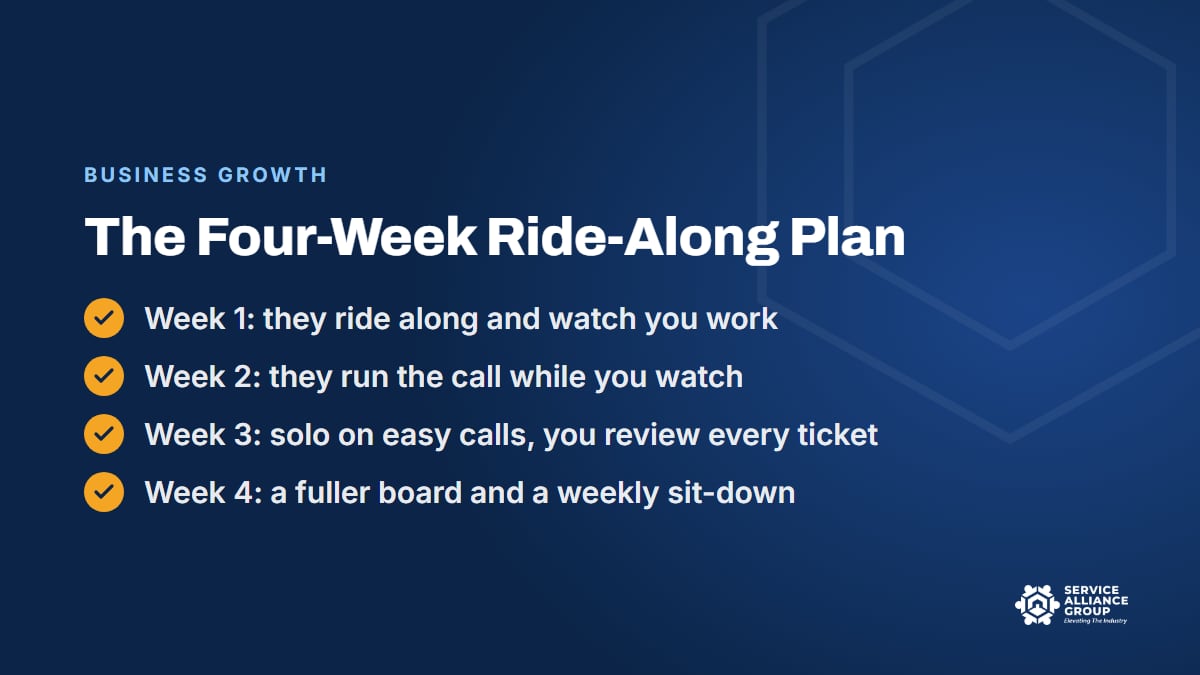
Then run a ride-along plan you wrote down before hiring, not one you improvise call by call:
- Week one: they ride with you or your lead tech and watch. Every call, they see the on-my-way text go out, the parking, the knock, the floor protection, the customer interview, and the options presented at the end. They learn your ticket notes and your parts process.
- Week two: they run the call and you watch. You are in the room, quiet, taking notes for the drive to the next stop. You step in only for safety or a customer issue.
- Week three: solo on the easy calls. A dryer that will not start, a dishwasher that will not drain, calls where the diagnosis is usually clear. You review every ticket that night: the notes, the parts, the photos, and the price.
- Week four: a fuller board and a weekly sit-down. By now you know their pace. Add calls as their first-time complete rate holds, not as your board demands.
Give them the customer side too, in short lessons they can watch during downtime. Our free 5 Star Service Calls course covers the on-my-way message, the door, floor protection, explaining in plain words, offering options instead of one price, and asking for the review, in 38 short lessons. Pair it with your own written procedures so every appliance technician learns the job the same way. If those are not written yet, start with how to write appliance repair SOPs.
Step 8: Manage the First 30 Days and Know When It Is Not Working
The first month after hiring is a trial for both of you, and it needs numbers. Once a week, look at the same short list together:
- Calls completed and first-time complete rate
- Callbacks, and what caused each one
- Average ticket compared with the shop's average
- Parts ordered versus parts returned
- Reviews or complaints that mention them by name
- Ticket notes a second tech could act on without calling them
Praise in specifics, correct in specifics, and write both down. At day 30, sit down and say plainly what is working, what is not, and what changes in the next 30, then give them a written copy of that plan.
Sometimes it does not work out. A few problems are serious enough to act on quickly: a safety shortcut with gas or electricity, dishonesty on a ticket or a timesheet, or a pattern of customer complaints that coaching does not change. Others, like slow diagnostics, are usually a training problem. Before you decide it is the person, check the process: whether the expectations were written down, whether the ride-along plan was followed, and whether anyone reviewed the tickets.
If you do have to let someone go, do it with documentation, follow your state's rules on final paychecks and any required separation notices, and get advice from an employment attorney or HR professional first. Then look at your hiring process with fresh eyes before you post the next ad, so the next time you hire an appliance repair technician goes better than the last.

Where the S.O.S. Course Scale Stage Fits
Hiring is part of a bigger question: how do you build a shop that runs on a team instead of on you? That is the Scale stage of the S.O.S. Course, the third of three stages in one course. It covers when to hire, the first hire, comp models, onboarding and ride-alongs, fleet costs, the management layer, commercial work, and valuation and exit options.
The whole course is 70 lessons and more than 21 hours, with 70 downloadable tools including 12 live spreadsheets, a quiz at the end of each stage, a master test, and a certificate of completion. Service Alliance Group is an alliance of appliance repair business owners, and co-founder TK Cousins runs a profitable multi-tech appliance repair company he built from the ground up.
For the paperwork, the SOP Library has 159 editable documents in 13 categories. Its Hiring and Recruiting and HR Policies categories include documents such as job listings, employment applications, and corrective action plans. The library is available on its own or as part of monthly All-Access, which also includes every course.
Frequently Asked Questions
How do I know I can afford to hire an appliance repair technician?
Run the numbers before you start hiring. Add up the fully loaded weekly cost of a tech seat (wage, payroll taxes, van, fuel, insurance, phone, tools), then compare it with the revenue from the calls you are turning away or pushing out. The Cost of Doing Business calculator shows how the hire changes your cost per service call. If that overflow could fill most of a board, the numbers are on your side. If it fills two days a week, wait or fix the phone first.
Should my first hire be a technician or a CSR?
Hire for the bottleneck. If calls go unanswered while you are on jobs, a CSR or an answering service that books calls often comes first, because a missed call can easily become another shop's job. If the phone is handled and the board is full, it is time to hire an appliance repair technician. Before you do, make sure your phone setup can keep a second board full, or the new tech will sit waiting for calls.
Should I pay an appliance technician hourly or commission?
For most shops, we would start with hourly plus a simple performance bonus. Straight commission can push rushed diagnostics and unnecessary parts, which costs you reviews and callbacks. Straight hourly does not reward a great day. Tie the bonus to first-time complete rate, callbacks, and revenue per day, keep it simple to calculate, and pay it often. Have your CPA or an employment attorney confirm the plan meets wage and hour rules before it goes in an offer letter.
What if the new technician is not working out?
Separate process failures from people failures. If the expectations were never written down or the ride-along was skipped, fix that first. Safety shortcuts, dishonesty, or repeated customer complaints that coaching does not change can be reasons to end it. Document everything, use a written corrective action plan, follow your state's rules on final pay, and talk with an employment attorney or HR professional before you act.
Hiring well is a skill, and like every other skill in this trade it gets better with reps and a written process. Do the eight steps in order and write down what you learn, and each appliance technician you hire should come on board a little more smoothly than the last.